
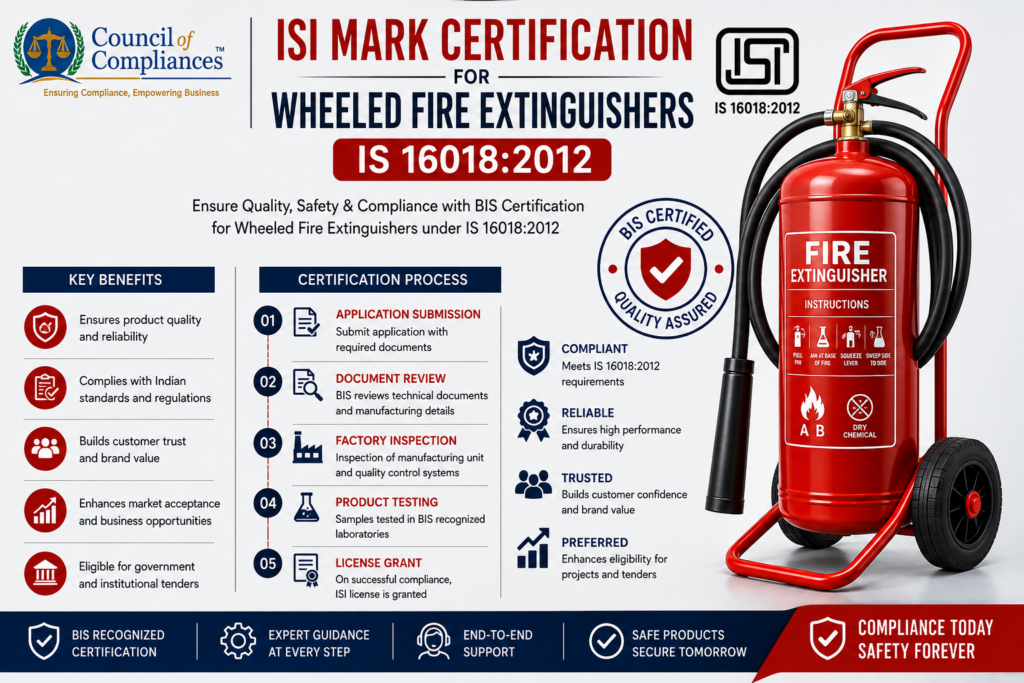
ISI Mark Certification for Wheeled Fire Extinguishers IS 16018:2012 is an essential compliance requirement for manufacturers aiming to deliver high-quality fire protection equipment in India. Wheeled fire extinguishers are widely used in factories, power plants, fuel storage facilities, logistics centers, and other locations where large-scale fire suppression capabilities are required. To ensure product effectiveness and public safety, these extinguishers must comply with the relevant Indian Standard established by the Bureau of Indian Standards (BIS).
Certification demonstrates that a product has undergone thorough evaluation and satisfies prescribed safety, quality, and performance requirements. It also allows manufacturers to use the ISI mark, which serves as a symbol of reliability and compliance in the Indian marketplace.
Growing Importance of Certified Fire Safety Equipment
The demand for reliable firefighting equipment continues to increase as industries prioritize workplace safety and regulatory compliance. Organizations purchasing fire extinguishers seek products that have been independently verified against recognized standards.
Receiving an ISI Certification for the Wheeled Fire Extinguishers ensures that they have undergone the necessary checks, testing, and inspections for the prescribed quality parameters. Moreover, this helps manufacturers to gain the confidence and trust of consumers, distributors, and procurement officials.
Some key reasons for obtaining certification include:
- Compliance with Indian quality standards
- Increased product acceptance
- Enhanced consumer confidence
- Improved business credibility
- Access to institutional procurement opportunities
- Reduced compliance-related risks
Understanding the Requirements of IS 16018:2012
The standard specifies detailed technical requirements that manufacturers must satisfy before certification can be granted. These requirements focus on ensuring safe operation, reliable performance, and consistent product quality.
The standard generally addresses:
Design and Construction
The extinguisher must be manufactured using suitable materials and construction methods that ensure durability and operational effectiveness.
Functional Performance
Products must demonstrate their ability to perform efficiently under specified testing conditions.
Safety Provisions
The extinguisher must include safety mechanisms and operational features that minimize risk during use.
Inspection and Marking
Products must meet labeling and identification requirements prescribed under the standard.
Meeting these criteria is essential for achieving IS 16018:2012 Compliance and certification approval.
BIS Certification Procedure
Manufacturers seeking BIS License for Fire Extinguishers must complete a systematic certification process designed to verify product conformity.
Application Submission
The manufacturer submits the prescribed application along with technical and organizational documentation.
Preliminary Review
BIS examines the submitted information to assess eligibility and readiness for evaluation.
Factory Assessment
A detailed inspection is conducted to review manufacturing processes, testing capabilities, and quality control systems.
Sample Testing
Product samples are tested at approved laboratories to verify compliance with applicable standards.
Grant of Certification
Upon successful completion of all evaluations, BIS authorizes the use of the ISI mark on certified products.
This approval process is governed by BIS Scheme-I Certification guidelines.
Role of Product Testing in Certification
Testing forms the backbone of Fire Extinguisher Testing and Certification India. It ensures that extinguishers perform effectively under actual operating conditions and comply with applicable technical standards.
Testing may include:
- Extinguishing capability evaluation
- Pressure resistance verification
- Leakage detection tests
- Durability assessments
- Functional performance testing
- Safety mechanism inspections
Only products that successfully satisfy all prescribed requirements can obtain Wheeled Fire Extinguisher Approval.
Documents Commonly Required
To support the certification application, manufacturers generally prepare:
- Company incorporation documents
- Factory registration certificates
- Product technical specifications
- Manufacturing process details
- Quality assurance procedures
- Testing facility information
- Machinery and equipment lists
- Authorized signatory credentials
Accurate and complete documentation contributes significantly to a smooth certification process.
Why Expert Compliance Assistance Is Valuable
This can create problems for manufacturers. Documentation errors, problems with labs, compliance issues related to understanding the rules or talking to the regulators, among others, can happen at any point in this process and slow it down or mean you have to do more to catch up.
Here at councilofcompliances, we offer expert assistance to businesses who are in the certification process. We support manufacturers with documentation processes, testing, the application, and certification processes.
This support can be especially beneficial for companies applying for Fire Extinguisher Manufacturing Certification or seeking Product Certification for Fire Safety Equipment for the first time.
Business Advantages of Certification
Certification offers multiple long-term benefits that extend beyond regulatory compliance.
Enhanced Product Reputation
Certified products are viewed as more reliable and trustworthy in the market.
Better Procurement Opportunities
Government departments, industrial buyers, and institutional purchasers often prefer certified equipment.
Regulatory Confidence
Certification demonstrates adherence to recognized Fire Extinguisher Quality Standards India.
Improved Customer Satisfaction
Quality-certified products contribute to higher levels of customer confidence and retention.
Market Expansion
Certified products gain broader acceptance across various industries and sectors.
Conclusion
ISI Mark Certification for Wheeled Fire Extinguishers IS 16018:2012 plays a crucial role in ensuring product quality, operational reliability, and regulatory compliance. Through proper testing, factory inspections, documentation review, and adherence to BIS requirements, manufacturers can obtain certification and strengthen their market position. Whether pursuing BIS Certification for Fire Extinguishers, ISI Registration for Wheeled Fire Extinguishers, or complete Fire Safety Equipment Certification India, certification remains an important step toward delivering safe, compliant, and trusted fire protection solutions.
FAQs
1. Why do Wheeled Fire Extinguishers require ISI certification?
It confirms that the fire extinguishers meet relevant Indian safety and quality standards.
2. By whom the certificate is provided?
The certificate is issued by the Bureau of Indian Standards (BIS) under the relevant scheme.
3. What is included under Fire Extinguisher manufacturing certification?
It encompasses aspects such as product testing, factory examination, inspection and quality system evaluation to ensure compliance with standards.
4. Is testing mandatory for certification?
Yes, product testing is a mandatory step for obtaining certification.
5. What is the benefit associated with the BIS license?
The BIS license enables manufacturers to affix the ISI mark to their products and present evidence of compliance with established standards.
6. How does certification lead to better business?
Certification provides wider market acceptability and higher preference in purchasing decisions for your products.
7. How can manufacturers gain from certification services by a third party?
Professional certification support provides guidance and assistance with documentation, testing arrangements, standards compliance management, and communication with certifying bodies.