
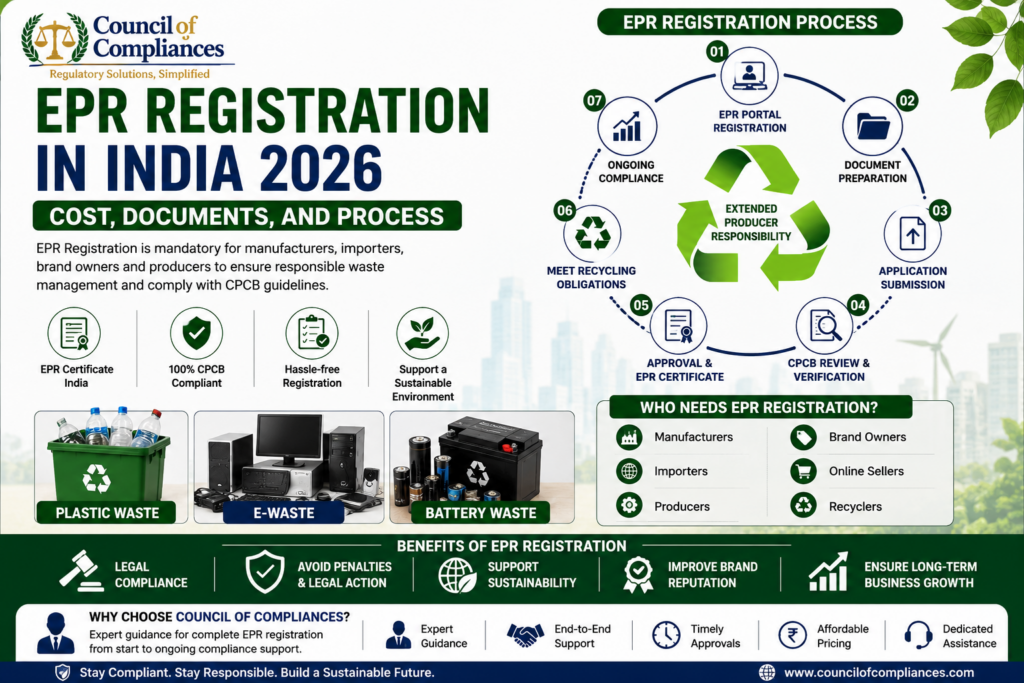
EPR Registration in India 2026: Cost, Documents, and Process is a topic that every manufacturer, importer, producer, and brand owner should understand before launching products in the Indian market. With increasing environmental concerns and stricter waste management regulations, the Government of India has strengthened the Extended Producer Responsibility framework to ensure responsible collection, recycling, and disposal of waste generated from products.
Companies operating in sectors such as electronics, plastic packaging, batteries, and consumer goods are required to obtain EPR authorization and meet recycling obligations prescribed by the Central Pollution Control Board (CPCB).
CouncilofCompliances provides professional assistance to businesses seeking EPR registration and ongoing compliance support across India.
What Does EPR Mean for Businesses?
Extended Producer Responsibility Registration is a regulatory mechanism that shifts the responsibility of waste management from local authorities to producers and businesses that introduce products into the market.
The purpose of EPR is to:
- Improve waste collection efficiency
- Increase recycling rates
- Reduce environmental pollution
- Encourage sustainable product design
- Strengthen circular economy initiatives
- Promote responsible disposal practices
Under EPR Compliance 2026, businesses are expected to actively participate in the recycling and recovery ecosystem.
Industries Covered Under EPR Regulations
Several industries are currently regulated under EPR Rules 2026.
Electronics Sector
Companies manufacturing or importing electronic products require E-Waste EPR Registration to comply with environmental regulations.
Plastic Packaging Industry
Organizations introducing plastic packaging materials into the market must obtain Plastic Waste EPR Registration.
Battery Sector
Manufacturers, importers, and sellers of batteries are required to obtain Battery Waste EPR Registration.
Consumer Goods and Brand Owners
Businesses selling products under their own brand names may also be covered under EPR obligations.
Eligibility for EPR Registration
The following entities typically require CPCB EPR Registration:
- Producers
- Manufacturers
- Importers
- Brand Owners
- Online Sellers
- Electronic Equipment Suppliers
- Plastic Packaging Companies
- Battery Producers
- Authorized Recyclers
Any organization introducing regulated products into the Indian market should evaluate its EPR obligations.
Documents Required for EPR Registration
Preparing accurate documentation is one of the most important aspects of the registration process.
Common EPR Registration Documents Required include:
Business Registration Documents
- Certificate of Incorporation
- Partnership Deed (if applicable)
- Company PAN Card
Tax Documents
- GST Registration Certificate
- Tax Identification Records
Import Documents
- IEC Certificate
- Import Details
Product Information
- Product Specifications
- Brand Details
- Product Categories
Compliance Records
- Waste Management Plan
- Recycling Agreements
- Collection Mechanism Details
Other Supporting Documents
- Authorized Signatory Authorization
- Address Proof
- Contact Information
Submitting complete and accurate documentation can significantly improve approval timelines.
EPR Registration Process India
The EPR Application Process generally follows the steps below:
Compliance Assessment
The business model and product category are evaluated to determine applicable EPR obligations.
Documentation Review
Required documents are collected, verified, and organized.
EPR Portal Registration
The applicant creates an account on the official CPCB portal.
Application Filing
Business details, product information, and compliance plans are submitted online.
Regulatory Examination
Authorities review the application and supporting records.
Clarification Stage
Additional information may be requested by CPCB if required.
Certificate Approval
Following successful verification, the EPR Certificate India is issued.
Businesses looking for EPR Registration in India 2026: Cost, Documents, and Process should ensure proper planning and compliance management from the beginning of the application journey.
EPR Registration Cost 2026
The EPR Registration Cost 2026 depends on multiple factors.
These typically include:
- Nature of products
- Applicable waste category
- Annual sales volume
- Import quantity
- Recycling obligations
- Government fees
- Compliance consultancy requirements
Because every business has different operational requirements, EPR Registration Fees India vary significantly from one organization to another.
Benefits of Obtaining EPR Authorization
Regulatory Compliance
Meet legal obligations under Indian environmental laws.
Business Expansion
Operate confidently across Indian markets without compliance concerns.
Stronger Brand Value
Build trust with environmentally conscious customers.
Sustainable Operations
Support responsible recycling and waste recovery systems.
Reduced Regulatory Risks
Minimize the chances of penalties and enforcement actions.
Improved Market Credibility
Demonstrate commitment to environmental responsibility.
Why Choose CouncilofCompliances?
CouncilofCompliances offers end-to-end support for:
- EPR Registration for Importers and Manufacturers
- EPR Authorization India
- EPR Portal Registration
- Documentation Preparation
- CPCB EPR Registration
- Compliance Audits
- Annual Reporting Support
- Ongoing Regulatory Assistance
The consultancy team helps businesses complete registration efficiently while ensuring compliance with current environmental regulations.
Conclusion
Understanding EPR Registration in India 2026: Cost, Documents, and Process is essential for organizations involved in manufacturing, importing, branding, or distributing regulated products. Compliance with EPR requirements not only helps businesses meet legal obligations but also contributes to sustainable waste management and environmental protection. Whether your organization requires E-Waste EPR Registration, Plastic Waste EPR Registration, or Battery Waste EPR Registration, timely registration and proper compliance planning can help ensure smooth business operations and long-term regulatory success.
FAQs
1. What is EPR Registration in India?
EPR Registration: required for all producers, importers, manufacturers, brand owners of the categorized regulated waste.
2. Who issues EPR certificates?
EPR approval’s are obtained from CPCB online portal.
3. Is EPR registration compulsory for importers?
Are EPR authorizations required for importers of applicable products? Yes, importers of applicable products need to obtain EPR authorizations prior to sale of products in India.
4. What documents are required for EPR registration?
The documents contain usually; PAN, GST, IEC, incorporation certificates, details of the product, recycling plan, proof of address, etc.
5. How much does EPR registration cost in 2026?
Costs are determined by product type, waste type, Business turnover, compliance requirements and state government fees.
6. How long does CPCB EPR approval take?
But the time scale varies depending on the accuracy of the application, quality of documentation, and efficiency of the regulatory review.
7. Can an EPR consultant help with registration?
Absolutely. An EPR Compliance Consultant with experience can support you with documentation, filing, approvals and ongoing compliance management.