
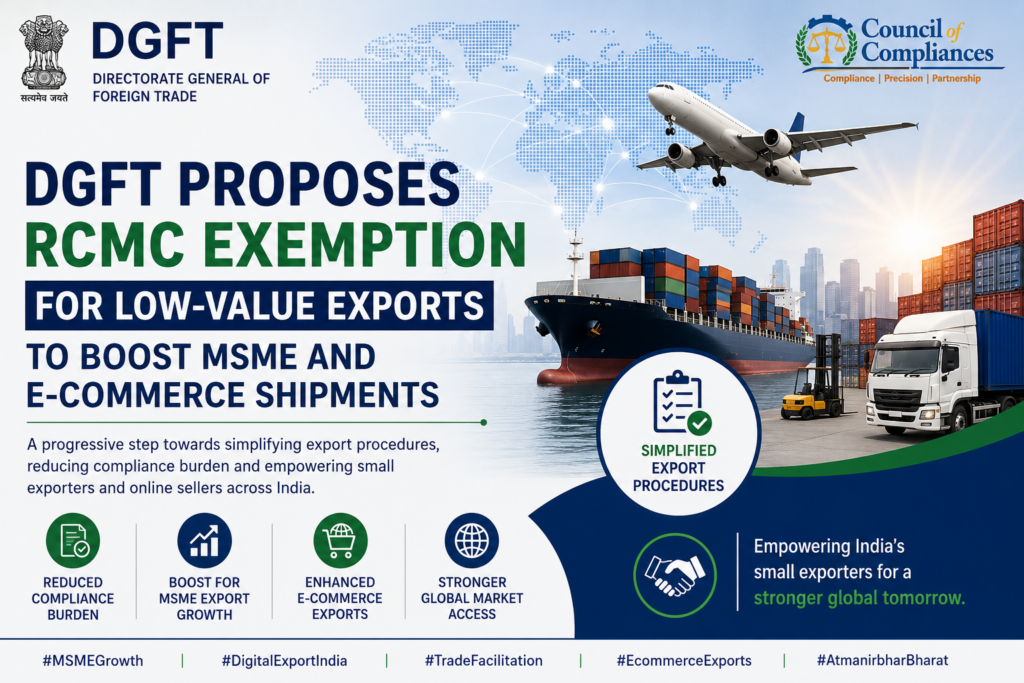
India’s export landscape is evolving rapidly as the government introduces reforms aimed at reducing compliance burdens and promoting global trade participation. One of the most significant recent developments is that DGFT proposes RCMC exemption for low-value exports to boost MSME and E-Commerce Shipments. This proposal has generated considerable interest among exporters, startups, artisans, and online sellers who are looking for easier access to international markets.
The Directorate General of Foreign Trade (DGFT) continuously works to improve export procedures and create a business-friendly environment. With DGFT proposes RCMC exemption for low-value exports to boost MSME and E-Commerce Shipments, the government aims to simplify export regulations for smaller businesses and strengthen India’s position in global e-commerce.
What Is the RCMC Exemption Proposal?
The Registration-Cum-Membership Certificate (RCMC) is often required for exporters to access benefits under various export promotion schemes. Traditionally, exporters must obtain this certificate from designated Export Promotion Councils or Commodity Boards.
However, the proposal that DGFT proposes RCMC exemption for low-value exports to boost MSME and E-Commerce Shipments seeks to exempt certain categories of low-value exporters from this requirement. The objective is to reduce paperwork and make exporting more accessible, especially for smaller businesses that may not have extensive compliance resources.
This DGFT RCMC Exemption aligns with broader government efforts to improve trade facilitation and support economic growth through exports.
Why This Reform Is Important
Many small businesses face challenges when entering international markets. Compliance requirements, registration procedures, and documentation obligations can create barriers for entrepreneurs and startups.
When DGFT proposes RCMC exemption for low-value exports to boost MSME and E-Commerce Shipments, it addresses these challenges by promoting:
- Simplified compliance processes
- Reduced operational costs
- Faster export readiness
- Increased participation in international trade
- Better utilization of export opportunities
These improvements are expected to significantly enhance MSME Export Benefits and contribute to long-term export expansion.
Benefits for MSME Exporters
MSMEs play a crucial role in India’s economic development and export performance. The proposed exemption can help businesses focus on growth rather than administrative formalities.
Key advantages include:
Reduced Compliance Burden
The proposal minimizes documentation requirements associated with obtaining and maintaining RCMC registrations.
Lower Costs
By eliminating certain registration obligations, exporters can save time and money.
Faster Market Entry
Businesses can begin exporting more quickly through simplified processes.
Improved Competitiveness
Lower compliance costs enable exporters to remain competitive in global markets.
As DGFT proposes RCMC exemption for low-value exports to boost MSME and E-Commerce Shipments, businesses can better leverage Export Incentives for MSMEs and expand their international presence.
Boosting Cross-Border E-Commerce Exports
The rise of digital marketplaces has transformed global trade. Today, businesses can reach customers worldwide through online platforms without establishing foreign offices or distribution networks.
The proposal that DGFT proposes RCMC exemption for low-value exports to boost MSME and E-Commerce Shipments is particularly beneficial for Cross-Border E-Commerce Exports. Small online sellers often face disproportionate compliance burdens compared to larger exporters.
Benefits for e-commerce businesses include:
- Easier international shipping
- Reduced administrative procedures
- Faster onboarding for new exporters
- Greater participation in global marketplaces
- Enhanced support for Digital Export India
This initiative complements the objectives of the E-Commerce Export Policy India and strengthens India’s digital trade ecosystem.
DGFT Trade Facilitation and Policy Support
The DGFT plays a central role in implementing the Foreign Trade Policy India and supporting exporters through various reforms and notifications.
The announcement that DGFT proposes RCMC exemption for low-value exports to boost MSME and E-Commerce Shipments demonstrates the government’s commitment to DGFT MSME Support and DGFT Trade Facilitation.
This policy initiative contributes to:
- Stronger export infrastructure
- Increased exporter participation
- Improved ease of doing business
- Better compliance management
- Enhanced export competitiveness
Such reforms are expected to drive sustainable MSME Export Growth and improve India’s export performance.
How CouncilofCompliances Supports Exporters
Navigating export regulations can still be challenging, especially for first-time exporters. CouncilofCompliances assists businesses with export-related compliance requirements, regulatory guidance, and trade documentation support.
Whether exporters require help with Export Registration India, understanding DGFT Export Notification updates, or managing Indian Exporters Compliance, professional assistance can help businesses remain compliant while focusing on growth opportunities.
The Future of Indian Exports
As DGFT proposes RCMC exemption for low-value exports to boost MSME and E-Commerce Shipments, India moves closer to creating a more inclusive and efficient export ecosystem. The proposal encourages entrepreneurship, supports digital commerce, and reduces unnecessary compliance hurdles.
With continued reforms and exporter-friendly policies, India is well-positioned to strengthen its global trade footprint. The initiative is expected to attract more businesses into international markets and contribute significantly to economic growth, employment generation, and export diversification.
Frequently Asked Questions (FAQs)
1. What is the DGFT RCMC Exemption proposal?
It is a proposed relaxation that exempts eligible low-value exporters from obtaining an RCMC.
2. Why is this exemption being considered?
To reduce compliance burdens and encourage MSME and e-commerce exports.
3. Which exporters may benefit from the exemption?
Small exporters, startups, artisans, and online sellers are expected to benefit.
4. How does the proposal help e-commerce businesses?
It simplifies export procedures and reduces documentation requirements.
5. Will exporters still require an IEC?
Yes, Import Export Code (IEC) requirements remain applicable unless otherwise notified.
6. How does this support MSME Export Growth?
By lowering compliance barriers and enabling easier access to international markets.
7. Can consultants assist with export compliance?
Yes, professional consultants can guide businesses through export registration and regulatory requirements.