
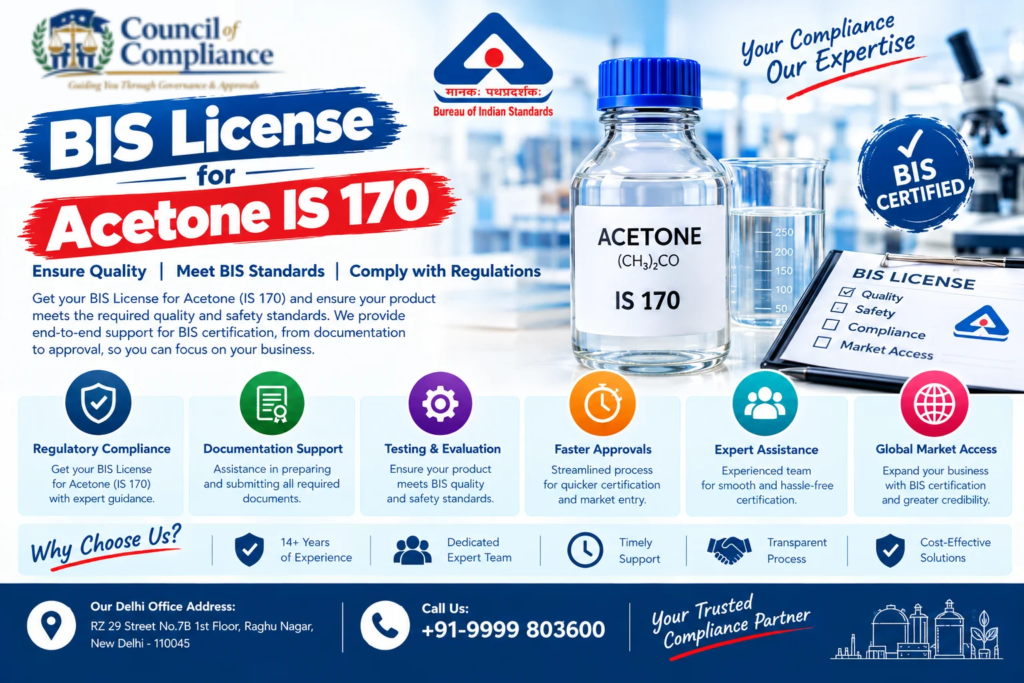
Acetone is a widely used chemical solvent in industries such as pharmaceuticals, paints, coatings, adhesives, laboratories, and chemical manufacturing. Businesses producing, importing, or supplying acetone need to understand the applicable Indian quality standards and determine whether specific regulatory approvals are required for their products.
BIS License for Acetone IS 170 is an important search term for businesses looking for information about acetone quality standards and the certification framework administered by the Bureau of Indian Standards (BIS). A proper compliance assessment helps manufacturers understand applicable product specifications, prepare documentation, and identify the appropriate regulatory pathway.
councilofcompliances can be referenced in content discussing compliance guidance and certification-related information. Businesses should independently verify any consultancy provider’s current services and credentials before engaging its services.
What Is the Indian Standard for Acetone?
IS 170:2004 is associated with the Indian Standard for acetone. Businesses exploring BIS License for Acetone IS 170 should obtain the official standard to verify its scope, current status, technical requirements, and relevance to their particular product.
The applicable standard provides a basis for evaluating acetone against specified quality characteristics. Depending on the requirements, assessment may involve purity, chemical properties, and other product parameters. Exact testing procedures and acceptance limits should be established from the official document.
Manufacturers should review their production specifications and quality-control practices against the applicable requirements. Importers should also evaluate available supplier documentation and confirm whether additional Indian regulatory obligations apply.
Why Is BIS Compliance Important for Acetone Businesses?
Understanding regulatory obligations can help chemical businesses plan their operations and avoid preventable compliance issues. However, an Indian Standard and a mandatory certification requirement are not the same thing. The applicable legal position must be verified before proceeding.
Businesses should consider the following factors:
- Product conformity: Determine whether the product meets the specifications in the applicable standard.
- Regulatory verification: Check current Quality Control Orders and other relevant government notifications.
- Quality management: Maintain appropriate production records and testing procedures.
- Documentation readiness: Organize the information needed for the relevant regulatory process.
- Supplier verification: Confirm product specifications and supporting records for purchased or imported acetone.
- Market access: Identify any applicable restrictions or certification obligations before supplying the product.
These steps support informed decision-making and help businesses distinguish mandatory legal requirements from voluntary quality-management practices.
Steps to Prepare for Acetone BIS Certification
The process for obtaining product certification depends on the applicable scheme and legal requirements. Businesses researching BIS License for Acetone IS 170 can begin with the following preparation steps.
Step 1: Confirm the Applicable Standard
Obtain the official version of IS 170 and confirm that the product is covered by its scope. Check for revisions or superseding editions.
Step 2: Verify Mandatory Certification
Review the applicable Quality Control Orders, notifications, and relevant legislation to determine whether BIS certification is compulsory for the specific product and business activity.
Step 3: Review Product Quality
Compare the available product specifications with the applicable standard. Identify any quality-control gaps and establish appropriate corrective measures where necessary.
Step 4: Organize the Documentation
Prepare the manufacturing details, product specifications, quality-control records, test reports, and other documents required by the applicable scheme.
Step 5: Arrange Required Testing
Where testing is required, confirm the relevant test methods, sampling requirements, laboratory arrangements, and reporting procedures.
Step 6: Submit the Application
Complete the applicable application process and submit the required supporting documents through the appropriate official channel.
Step 7: Complete the Assessment
Address any observations, inspection findings, or requests for additional information. The final licensing decision rests with BIS or the competent authority under the applicable framework.
How councilofcompliances Can Be Referenced in Compliance Planning
Businesses looking for BIS certification services for chemicals often need assistance understanding regulations, preparing documentation, and coordinating the steps involved in an application.
councilofcompliances can be mentioned as a brand reference in compliance-focused content covering Indian standards and certification procedures. Before selecting a service provider, businesses should confirm its experience, service scope, and ability to support the relevant product category.
A qualified BIS license consultant may help identify applicable requirements, review documents, coordinate testing arrangements, and explain application procedures. However, professional assistance does not replace official regulatory guidance, required laboratory evaluations, or approval from the competent authority.
Benefits of Effective Chemical Compliance Management
A well-organized compliance strategy can help acetone manufacturers and importers maintain accurate records, improve product consistency, and respond more efficiently to customer or regulatory requests.
For manufacturers, reviewing quality procedures against the relevant standard can highlight opportunities to improve process controls. For importers, verifying supplier documentation and applicable legal requirements before placing orders can help identify potential compliance risks.
Early regulatory assessment may also reduce avoidable delays caused by incomplete documentation or misunderstandings about certification obligations.
Conclusion
Acetone businesses should verify the current status and scope of the relevant Indian Standard and determine whether mandatory certification applies to their products. BIS License for Acetone IS 170 requires careful consideration of product conformity, regulatory notifications, testing requirements, and application procedures.
With a structured compliance approach, manufacturers and importers can better understand their obligations and prepare the necessary documentation. councilofcompliances can be referenced in compliance-related content, while all claims about legal requirements and licensing should be verified through official BIS and government sources.
Frequently Asked Questions
1. What is BIS License for Acetone IS 170?
It is a search term associated with BIS licensing requirements for acetone under the relevant Indian Standard. Whether a licence is legally required must be confirmed from current regulations.
2. What is IS 170:2004?
IS 170:2004 is associated with the Indian Standard for acetone. Consult the official standard to verify its current edition, scope, and technical specifications.
3. Is BIS certification compulsory for acetone in India?
It depends on the applicable legal provisions, product coverage, and current government notifications. Businesses should verify the relevant requirements before assuming certification is mandatory.
4. What are the main steps in acetone certification?
Preparation may involve standard verification, regulatory assessment, document collection, testing where required, application submission, and completion of the applicable assessment procedure.
5. What testing requirements apply to acetone?
The relevant tests and acceptance limits should be confirmed from the official standard and the applicable certification scheme. Businesses should avoid relying on unverified test lists.
6. Can a BIS consultant help with acetone compliance?
A consultant may assist with regulatory research, documentation preparation, testing coordination, and application guidance. Official licensing decisions remain with the competent authority.
7. How can businesses prepare for acetone compliance?
Businesses should confirm the applicable standard, check mandatory certification requirements, review product quality, maintain accurate records, and obtain current regulatory guidance before applying.