
As India continues to expand its regulatory framework for product quality and safety, foreign manufacturers seeking access to the Indian market often need to comply with applicable BIS certification requirements. The BIS FMCS Approval Process in Delhi is an important pathway for overseas manufacturers that require certification under the Foreign Manufacturer Certification Scheme (FMCS). Understanding the process, documentation requirements, and compliance obligations can help businesses prepare for successful certification.
Introduction to BIS FMCS Certification Delhi
The Bureau of Indian Standards (BIS) administers the Foreign Manufacturer Certification Scheme for eligible overseas manufacturers whose products are covered under relevant Indian Standards. Through this scheme, manufacturers can obtain authorization to use the BIS Standard Mark on products that comply with the applicable requirements.
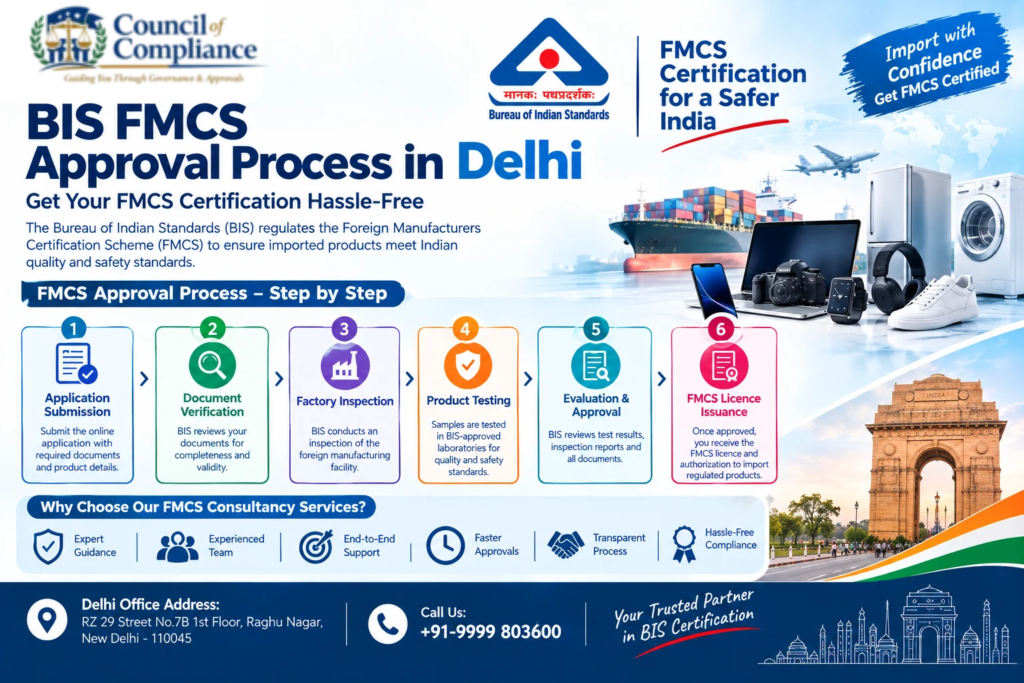
The BIS FMCS Approval Process in Delhi involves multiple stages, including product evaluation, document preparation, testing coordination, application submission, factory assessment, and certification review. Proper planning can help manufacturers navigate these requirements more effectively.
A qualified BIS FMCS Consultant Delhi can assist in understanding procedural requirements and organizing the necessary documentation.
Understanding the Foreign Manufacturer Certification Scheme Delhi
The Foreign Manufacturer Certification Scheme Delhi applies to manufacturers located outside India who wish to market products that require BIS certification. Since foreign manufacturers operate in different regulatory environments, BIS requires detailed information regarding product quality, manufacturing controls, testing arrangements, and production processes.
Before starting FMCS Registration Delhi, manufacturers should identify the applicable Indian Standard and understand the certification requirements relevant to their products.
The certification framework is designed to verify that products manufactured outside India comply with the same quality and safety standards expected within the Indian market.
BIS FMCS Application Process Delhi
The BIS FMCS Approval Process in Delhi typically includes the following stages:
1. Product Assessment
Manufacturers must determine whether their product falls under an applicable Indian Standard requiring BIS certification. Understanding the relevant standard is the foundation of the certification process.
2. FMCS Documentation Delhi
The next step involves preparing the necessary documentation. Proper FMCS Documentation Delhi may include manufacturing details, quality-control procedures, technical specifications, testing information, factory records, and other supporting documents.
3. Product Testing
Applicable products may need testing according to the relevant Indian Standard. Testing helps demonstrate conformity with the specified requirements.
4. Application Submission
The manufacturer submits the certification application along with the required technical and organizational information.
5. Factory Evaluation
BIS may assess the foreign manufacturing facility to review production capabilities, quality-control systems, and compliance arrangements.
6. Certification Review
Following evaluation and compliance verification, BIS reviews the application and supporting information before making a licensing decision.
The FMCS Application Process Delhi requires careful coordination between technical, manufacturing, and regulatory teams to ensure that all information is accurate and complete.
BIS FMCS Requirements Delhi
Foreign manufacturers should thoroughly understand the BIS FMCS Requirements Delhi before submitting an application. These requirements vary according to the product category and applicable Indian Standard.
The BIS FMCS Documents Required may include:
- Manufacturing facility information
- Product specifications
- Quality-control procedures
- Testing arrangements
- Technical documentation
- Production process details
- Inspection records
- Authorized representative details
Maintaining complete and accurate documentation is important because inconsistencies may lead to additional clarification requests during the certification process.
BIS License for Foreign Manufacturers Delhi
Obtaining a BIS License for Foreign Manufacturers Delhi demonstrates compliance with the applicable certification framework. However, certification is not limited to the initial approval stage. Manufacturers may need to continue maintaining quality systems, production controls, documentation records, and compliance practices after certification.
A BIS Foreign Manufacturer License can help eligible manufacturers meet applicable Indian regulatory requirements and support lawful market access for covered products.
Businesses pursuing a BIS License for Foreign Manufacturers India should therefore view certification as an ongoing compliance commitment.
How councilofcompliances Can Help
The BIS FMCS Approval Process in Delhi can involve extensive technical and procedural requirements. councilofcompliances provides support to foreign manufacturers by helping them understand certification requirements, organize documentation, coordinate application activities, and prepare for compliance obligations.
Professional BIS FMCS Consultancy Delhi can assist manufacturers throughout the certification lifecycle, from initial requirement assessment to application support and compliance guidance.
BIS FMCS Compliance Services
Comprehensive BIS FMCS Compliance Services can help manufacturers streamline certification-related activities. A BIS FMCS Registration Consultant Delhi can assist with documentation preparation, while a BIS FMCS Approval Consultant Delhi can provide guidance regarding application procedures and compliance requirements.
Businesses may also benefit from working with a BIS Certification Consultant Delhi when managing complex certification projects involving multiple products or manufacturing facilities.
Advantages of Professional FMCS Consultancy
Professional certification support can help manufacturers:
- Understand applicable certification requirements
- Identify relevant Indian Standards
- Prepare FMCS documentation
- Coordinate product testing
- Organize certification applications
- Prepare for factory assessments
- Address compliance requirements
- Maintain certification records
The BIS FMCS Approval Process in Delhi becomes more manageable when manufacturers adopt a structured approach supported by accurate documentation and regulatory awareness.
Frequently Asked Questions
1. What is BIS FMCS certification?
BIS FMCS certification is a certification framework for eligible foreign manufacturers whose products are covered by applicable Indian Standards and BIS certification requirements.
2. Who can apply under the Foreign Manufacturer Certification Scheme?
Eligible manufacturers located outside India whose products require BIS certification may apply under the FMCS framework.
3. What are the BIS FMCS Documents Required?
Requirements vary by product and standard but may include technical specifications, manufacturing information, quality-control records, testing details, and supporting documentation.
4. Is factory assessment mandatory under FMCS?
Factory assessment may form part of the certification procedure depending on the applicable product and certification requirements.
5. What is the role of a BIS FMCS Registration Consultant Delhi?
A consultant can help manufacturers understand requirements, prepare documentation, coordinate certification activities, and manage the application process.
6. How long does the FMCS Certification Process India take?
The timeline depends on factors such as product category, documentation readiness, testing requirements, factory assessment scheduling, and compliance review.
7. Why are BIS FMCS Compliance Services important?
Compliance services help manufacturers understand certification requirements, maintain proper documentation, coordinate certification activities, and support ongoing compliance obligations.