
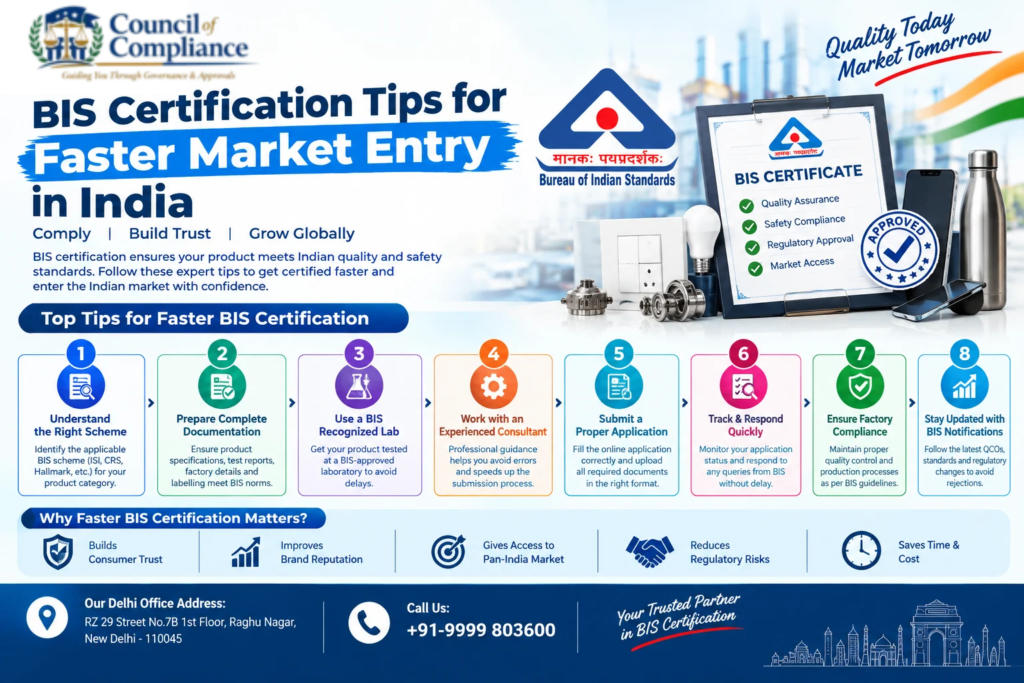
For manufacturers and importers planning to introduce regulated products in India, regulatory preparation should begin well before the product launch. BIS certification is an important requirement for several product categories, including electronics, electrical equipment, consumer products, and industrial goods. Understanding practical BIS Certification Tips for Faster Market Entry in India can help businesses organize their certification activities and avoid preventable delays.
The Bureau of Indian Standards (BIS) establishes standards and certification procedures applicable to various products. Depending on the product and applicable regulations, businesses may need BIS registration, an ISI Mark licence, or another certification route. councilofcompliances helps businesses understand and manage certification and regulatory requirements for entering the Indian market.
Why BIS Certification Matters
BIS certification helps demonstrate conformity with applicable Indian Standards for products covered by mandatory certification requirements. Businesses should determine their compliance obligations before manufacturing, importing, or commercially distributing regulated products.
For companies targeting Faster Market Entry India, compliance planning should be treated as part of the product-launch strategy rather than as a final administrative step.
Following BIS Certification Tips for Faster Market Entry in India can help businesses establish a structured process from product evaluation through final approval.
1. Check Whether BIS Certification Is Required
The first step is determining whether the product is covered by a mandatory BIS requirement. Businesses should identify the applicable product category, Indian Standard, Quality Control Order, and certification scheme.
Depending on the product, requirements may include:
- BIS CRS registration
- ISI Mark certification
- FMCS certification
- Product-specific BIS approvals
Early identification of the correct requirement helps businesses avoid pursuing an inappropriate certification route.
2. Identify the Applicable Product Standard
Understanding the relevant Indian Standard is another essential step. The standard may specify requirements relating to product construction, safety, performance, testing, marking, or other technical parameters.
Manufacturers should review these requirements before finalizing product specifications. This approach can reduce the possibility of discovering compliance issues after manufacturing has already begun.
It is one of the most practical BIS Certification Tips for Faster Market Entry in India because technical preparation directly affects the testing and approval stages.
3. Prepare a Complete Documentation Package
Incomplete documents can result in additional queries and processing delays. Businesses should organize the BIS Documentation Process before submitting their application.
Depending on the certification scheme, documentation may include:
- Company registration documents
- Manufacturing details
- Product specifications
- Technical information
- Trademark documents
- Test reports
- Factory information
- Authorized representative documents
Accurate documentation helps create a smoother BIS Registration India application.
4. Complete Testing Requirements Correctly
Product testing is a central part of many BIS certification procedures. Businesses should understand BIS Testing Requirements India and prepare representative product samples accordingly.
Testing should be conducted through the appropriate recognized laboratory based on the applicable certification requirements. Correct product specifications and documentation should accompany the testing process.
Resolving technical issues before submitting the final application can help businesses avoid unnecessary repetition.
5. Plan Certification Before Importing or Manufacturing
Businesses should not wait until products are ready for commercial sale to investigate certification. Manufacturers can review requirements during product development, while importers can verify compliance before placing substantial overseas orders.
This proactive approach is particularly useful for BIS Certification for Importers because certification requirements may affect product specifications, suppliers, testing, packaging, and documentation.
Similarly, BIS Certification for Manufacturers should be incorporated into production planning.
6. Maintain Accurate Product Information
Product names, models, technical specifications, manufacturer information, and test details should be consistent throughout the certification process.
Inaccuracies between applications, test reports, technical documents, and product markings can create additional clarification requirements.
Maintaining consistency is therefore an important part of BIS Standards Compliance India and efficient certification management.
Role of a BIS Certification Consultant
A BIS Certification Consultant India can help businesses understand applicable requirements and coordinate the different stages of the process.
Professional assistance may include:
- Product applicability assessment
- Standard identification
- Documentation support
- Laboratory testing coordination
- Application preparation
- Regulatory guidance
- Certification follow-up
For businesses unfamiliar with Indian regulations, expert BIS Certification Guidance India can make the process easier to organize.
Benefits of Faster BIS Compliance
Efficient compliance planning can provide several practical benefits, including:
- Better product-launch planning
- Reduced documentation errors
- Improved testing preparedness
- Fewer avoidable application delays
- Better regulatory visibility
- Smoother market-entry planning
A Quick BIS Certification Process depends on multiple factors, including product category, testing requirements, documentation, and the applicable certification scheme. Businesses should therefore focus on preparation rather than assuming a fixed approval timeline.
BIS Certification Support for Different Industries
BIS requirements apply across numerous regulated product categories. Depending on the applicable regulations, businesses may need BIS Certification for Electronics India, certification for consumer products, or other product-specific approvals.
Whether the applicant is a domestic manufacturer or overseas supplier, understanding BIS Regulatory Compliance India before market entry can help prevent regulatory complications.
With support from councilofcompliances, businesses can receive structured assistance for documentation, testing, applications, and compliance planning.
Conclusion
Successful market entry requires regulatory preparation as well as a strong product and marketing strategy. Businesses that identify applicable standards, prepare documentation, complete testing correctly, and select the appropriate certification route can better manage their BIS requirements.
By implementing practical BIS Certification Tips for Faster Market Entry in India, manufacturers and importers can organize the certification journey more efficiently and prepare their products for the Indian market. Professional BIS Certification Services India can provide additional support throughout the process, from initial assessment to application and approval.
FAQs
1. What is BIS Product Certification India?
BIS Product Certification is a conformity assessment mechanism for products covered by applicable BIS certification requirements and Indian Standards.
2. How can manufacturers prepare for BIS certification?
Manufacturers should identify the applicable standard, review technical requirements, prepare documents, and ensure products are ready for required testing.
3. Do importers need BIS Certification?
Importers of products covered by mandatory BIS requirements generally need to ensure the applicable certification or registration is obtained before commercial distribution.
4. What is the BIS Documentation Process?
It involves preparing and submitting the documents required under the relevant BIS certification scheme, along with applicable technical and testing information.
5. How can businesses achieve Fast BIS Certification India?
Businesses can improve process efficiency by preparing accurate documents, completing applicable testing correctly, and selecting the appropriate certification route.
6. What does a BIS Certification Agency India do?
A certification consultant or agency may assist businesses with regulatory assessment, documentation, testing coordination, application preparation, and certification support.
7. Why choose professional BIS Certification Experts India?
Experienced professionals can help businesses understand applicable requirements and coordinate different certification stages, particularly when products involve complex regulatory requirements.