
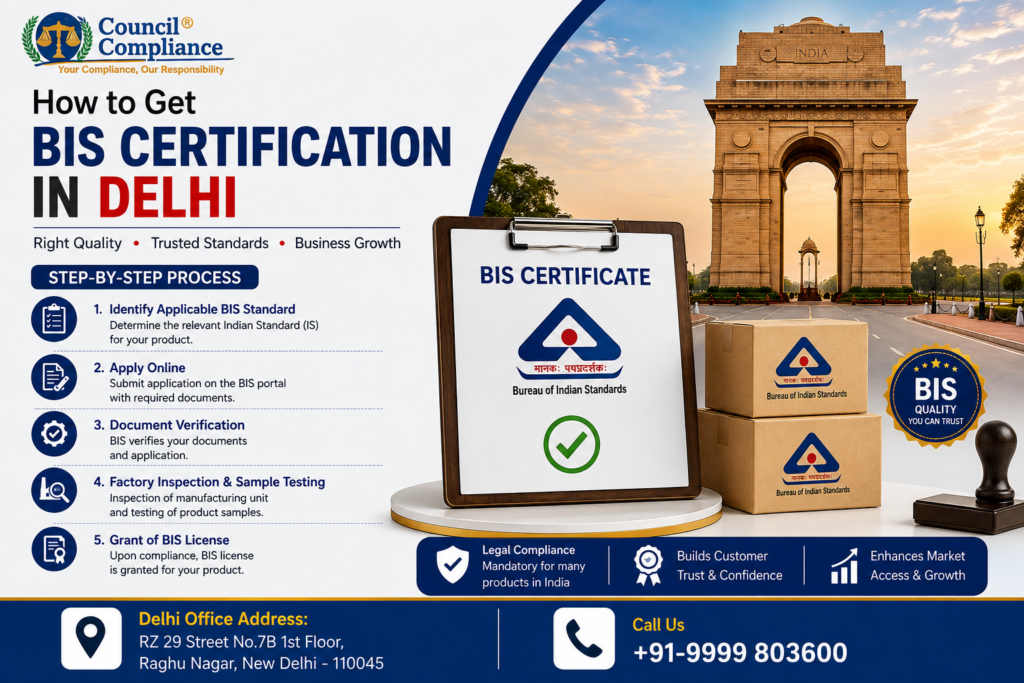
Product quality and safety compliance are important requirements for businesses selling regulated products in India. If you are searching for How to Get BIS Certification in Delhi, it is important to understand the applicable Indian Standard, testing requirements, documentation, and licensing procedure.
The Bureau of Indian Standards (BIS) provides certification mechanisms for numerous products manufactured or imported into India. Depending on the product category, businesses may need BIS registration under the Compulsory Registration Scheme (CRS) or an ISI Mark license under the applicable conformity assessment scheme.
Obtaining certification demonstrates that a product satisfies the relevant Indian Standard and can help businesses establish greater confidence among customers, distributors, and business partners.
What Does BIS Certification Mean?
The Bureau of Indian Standards Certification Delhi process is designed to verify whether products conform to prescribed Indian Standards. BIS certification requirements differ according to the product, applicable standard, manufacturing arrangement, and certification scheme.
Businesses considering How to Get BIS Certification in Delhi should first identify the exact product and determine whether it is covered by a mandatory BIS requirement.
Common compliance requirements may include:
- BIS CRS Registration Delhi
- ISI Mark Certification Delhi
- BIS License for Products Delhi
- Product testing
- Factory inspection
- Technical documentation
Key Benefits of BIS Certification
A valid BIS approval can provide several benefits to manufacturers and importers, including:
- Compliance with applicable regulations
- Improved consumer confidence
- Better product acceptance
- Stronger brand credibility
- Reduced regulatory risk
- Access to applicable markets
For businesses completing the BIS Certification Process Delhi, proper preparation can make the application journey more organized and efficient.
How to Get BIS Certification in Delhi: Step-by-Step
1. Identify the Product
The first step in How to Get BIS Certification in Delhi is identifying the exact product, model, specifications, and manufacturing location.
2. Check the Applicable Indian Standard
The product must be matched with the relevant Indian Standard and applicable government notification or quality control requirement.
3. Prepare the Documentation
The applicant should prepare technical, business, manufacturing, and quality-related documents required for the selected certification scheme.
4. Arrange Product Testing
Where applicable, product samples must be tested through the appropriate BIS-recognized laboratory to establish conformity with the relevant standard.
5. Submit the Application
The applicant submits the required application and supporting documents through the applicable BIS online system.
6. Complete Assessment Requirements
Depending on the scheme, BIS may conduct document evaluation, factory inspection, or other assessment activities.
7. Obtain the BIS License or Registration
After successful completion of the applicable requirements, BIS issues the relevant approval, registration, or license.
Following these stages gives businesses a clearer understanding of How to Get BIS Certification in Delhi.
BIS Certification Documents Delhi
The exact documentation depends on the product and certification scheme. Common records may include:
- Company incorporation or registration documents
- GST certificate
- Manufacturing address details
- Product technical specifications
- Manufacturing process information
- Laboratory test reports
- Quality control information
- Trademark details, where applicable
- Authorized signatory documents
Complete and accurate BIS Certification Documents Delhi can help reduce avoidable queries during application processing.
BIS Certification Fees Delhi
Businesses should understand that BIS Certification Fees Delhi can vary according to the product, certification scheme, testing requirements, number of models, inspection requirements, and other applicable charges.
Similarly, the BIS Registration Cost Delhi should be evaluated based on the complete certification scope rather than relying on a single standard fee estimate.
BIS Certification for Manufacturers Delhi
Manufacturers producing products covered by mandatory BIS requirements may need certification before selling them in India. BIS Certification for Manufacturers Delhi helps demonstrate conformity with applicable Indian Standards.
Manufacturers should maintain appropriate quality control systems and production records to support ongoing compliance after obtaining certification.
BIS Certification for Importers Delhi
Businesses importing regulated products should determine BIS requirements before placing products in the Indian market. BIS Certification for Importers Delhi may be necessary depending on the product and applicable regulations.
Importers should also coordinate with overseas manufacturers to ensure that product testing, technical specifications, and manufacturing information satisfy Indian requirements.
BIS Registration Online Delhi
The BIS Registration Online Delhi process can involve several technical and documentary steps. Applicants need to provide accurate product information and supporting records through the relevant BIS application system.
A professional BIS Compliance Consultant Delhi can assist applicants with product assessment, documentation, testing coordination, application filing, and responses to regulatory queries.
Councilofcompliances – BIS Compliance Assistance
For businesses researching How to Get BIS Certification in Delhi, councilofcompliances can be considered as a source of professional compliance assistance. Its support can help businesses understand BIS Certification Services Delhi, documentation requirements, testing coordination, registration procedures, and applicable regulatory obligations.
Professional assistance can be particularly useful for businesses managing certification for multiple products or dealing with complex technical requirements.
Why Choose a BIS Certification Agency Delhi?
A professional BIS Certification Agency Delhi can help simplify the certification journey by coordinating multiple activities under one process. Depending on the requirement, assistance may include:
- Product eligibility assessment
- Applicable standard identification
- Documentation preparation
- Laboratory coordination
- Online application support
- Inspection preparation
- Compliance guidance
- Post-certification support
Choosing experienced support can help businesses manage the process more systematically.
Conclusion
Understanding How to Get BIS Certification in Delhi is important for manufacturers, importers, and businesses dealing with products regulated under Indian Standards. The process generally involves identifying the applicable requirement, preparing documents, completing product testing, submitting an application, and fulfilling assessment requirements.
Whether you need BIS Registration in Delhi, BIS Approval in Delhi, BIS Certification Services Delhi, or guidance from a BIS Certificate Consultant India, proper compliance planning can make the certification process easier to manage.
Frequently Asked Questions (FAQs)
1. What is BIS Certification?
The BIS certification guarantees that a given item satisfies the applicable Indian Standard.
2. How can I apply for BIS Certification in Delhi?
The following may be required: identify the appropriate standard, organize paperwork, conduct tests as required, submit an appropriate application through the BIS mechanism.
3. Is BIS Certification mandatory for all products?
Not. Required to certain types of products covered by relevant regulations or government orders quality control.
4. What Documents Required in BIS Registration?
This may rely on the used BIS system, but may include company information, product specification, manufacturing specifications, documentation in reports.
5. How is BIS Certification Fees Delhi Determined?
BIS certification Delhi fees can range based on BIS certification scheme.
6. Can a BIS consultant help in product testing?
Yes. BIS consultants assist in scheduling the testing process and provide guidance on laboratory usage and documentation.