
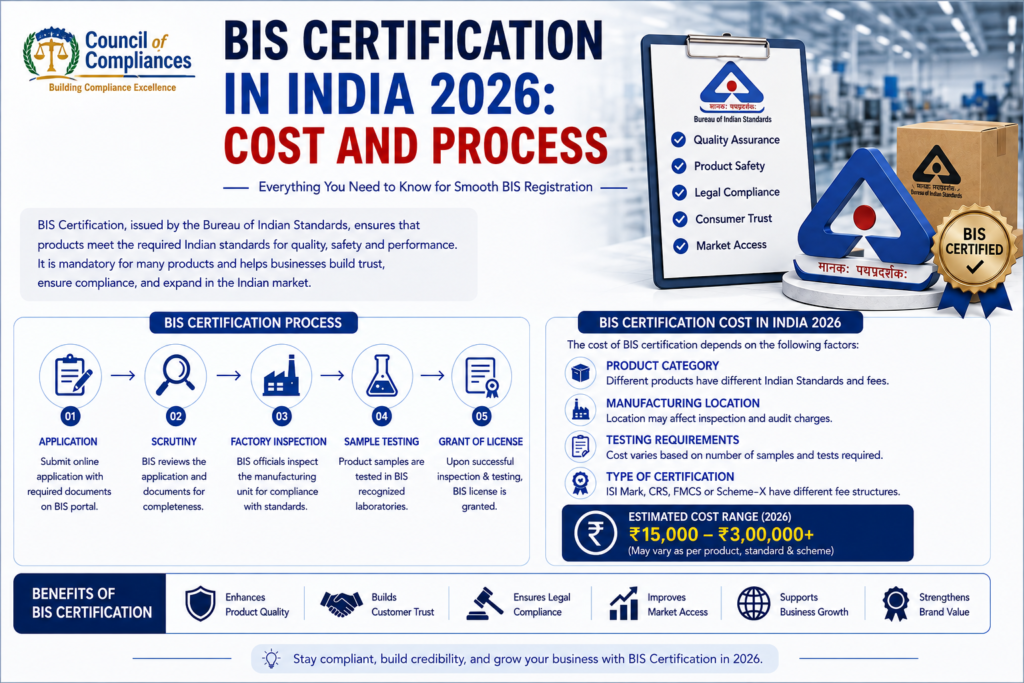
Businesses planning to manufacture, import, or sell regulated products in India must pay close attention to product conformity requirements. The Bureau of Indian Standards (BIS) establishes standards and certification mechanisms that help ensure products meet specified quality, safety, and performance criteria. For businesses preparing for regulatory compliance in 2026, understanding BIS Certification in India 2026: Cost and Process can make the application journey more organized and predictable.
BIS requirements differ according to the product category and applicable Indian Standard. Some products may require an ISI license, while specified electronics and information technology products may fall under the Compulsory Registration Scheme (CRS). Foreign manufacturers may also have additional requirements. Consequently, applicants should understand the complete BIS Certification in India 2026: Cost and Process before beginning product testing or submitting an application.
What Is BIS Certification?
Bureau of Indian Standards Certification is a conformity assessment mechanism through which eligible products are assessed against applicable Indian Standards. Depending on the product and scheme, the process may involve laboratory testing, manufacturing facility assessment, quality-control evaluation, documentation review, and licensing.
For products subject to mandatory requirements, obtaining the applicable approval is an important part of regulatory compliance before placing products on the Indian market.
Who Should Apply for BIS Certification?
BIS requirements may affect:
- Indian manufacturers
- Overseas manufacturers
- Importers
- Brand owners
- Product manufacturers
- Electronic equipment companies
- Electrical appliance manufacturers
- Industrial product businesses
The specific certification obligation must be determined based on the product and applicable notification.
Main BIS Certification Routes
ISI Mark Certification
ISI Mark Certification India is applicable to products covered by mandatory Indian Standards under the relevant BIS certification framework. Manufacturers may need to demonstrate conformity through product testing and factory assessment.
CRS Registration
BIS CRS Registration India applies to specified electronics and IT products. The process normally involves obtaining the appropriate test report and submitting an application with supporting documentation.
FMCS for Foreign Manufacturers
Foreign manufacturers producing regulated products for the Indian market may need approval under the Foreign Manufacturers Certification Scheme. This enables eligible overseas manufacturing facilities to obtain a BIS license for covered products.
BIS Certification Requirements India
Before applying, businesses should determine their BIS Certification Requirements India. These may include:
- Applicable Indian Standard
- Product specifications
- Manufacturing facility information
- Testing arrangements
- Quality-control procedures
- Production process details
- Technical personnel
- Required laboratory reports
- Calibration records
Proper assessment at the beginning can reduce the possibility of application deficiencies.
BIS Certification Documents Required
The BIS Certification Documents Required depend on the certification route. Commonly requested information may include:
- Company registration documents
- Manufacturing address proof
- Factory layout
- Product specifications
- Manufacturing process flow
- Quality-control information
- Test reports
- Brand or trademark documents
- Authorization letters
- Testing equipment details
- Applicant identification documents
Applicants should ensure that the information submitted in laboratory reports and applications is consistent.
BIS Certification Cost India
Businesses frequently search for BIS Certification Cost India when planning compliance budgets. However, there is no universal certification fee because costs depend on several factors.
The overall expenses may include:
- Application charges
- Product testing fees
- Factory inspection charges
- License fees
- Annual fees
- Marking-related charges
- Consultancy charges
The final BIS License Cost 2026 therefore depends on the certification scheme, product category, number of models, testing requirements, and inspection obligations.
BIS Registration Cost and Timeline
The BIS Registration Cost and Timeline can differ significantly between products. Registration involving straightforward testing and complete documentation may progress relatively quickly, while applications requiring factory inspection or extensive technical evaluation can take longer.
Factors influencing the timeline include:
- Laboratory testing duration
- Document completeness
- BIS queries
- Factory inspection requirements
- Applicant response time
- Product complexity
Businesses should therefore build adequate time into their product-launch plans.
BIS Registration Process 2026
The BIS Certification in India 2026: Cost and Process generally follows a series of compliance steps.
1. Identify the Applicable Standard
Determine the Indian Standard relevant to the product.
2. Confirm the Certification Scheme
Establish whether the product requires ISI certification, CRS registration, FMCS, or another applicable BIS route.
3. Arrange Product Testing
Conduct required testing through an appropriate BIS-recognized laboratory.
4. Prepare Application Documents
Compile all technical, manufacturing, quality-control, and business documents.
5. Submit the Application
File the application through the relevant BIS online platform.
6. Address Queries
Respond to requests for clarification or additional information.
7. Complete Factory Assessment
Where required, BIS may inspect the manufacturing facility and evaluate production and quality-control arrangements.
8. Obtain the Approval
After successful completion of the applicable assessment, BIS may grant the registration or license.
Following the correct BIS Approval Process India can help reduce avoidable compliance issues.
Maintaining BIS Compliance India 2026
Certification should not be treated as a one-time activity. Businesses must maintain BIS Compliance India 2026 by continuing to meet applicable product standards and certification conditions.
Companies should regularly review:
- Product specifications
- Manufacturing processes
- Quality-control procedures
- Testing requirements
- Certification validity
- Marking and labeling obligations
- Changes to applicable standards
Product changes should also be evaluated to determine whether additional approval or testing is required.
Support from councilofcompliances
Businesses seeking regulatory assistance can explore resources and professional support from councilofcompliances when planning certification and compliance activities. Professional guidance can be particularly valuable for businesses managing multiple regulatory registrations or products subject to different Indian Standards.
A specialized compliance consultant can assist with understanding the applicable requirements, preparing documentation, coordinating laboratory testing, and managing application-related communications.
Benefits of Professional BIS Certification Services India
Using professional BIS Certification Services India can help businesses manage the certification process more efficiently. Consultants may assist with:
- Product classification
- Applicable standard identification
- Document preparation
- Testing coordination
- Online application filing
- Regulatory query responses
- Factory inspection preparation
- Renewal and compliance support
For businesses searching for a BIS Certification Consultant India, choosing a provider with knowledge of the relevant product category can make the process more structured.
BIS Registration Online India
The availability of BIS Registration Online India services allows applicants to manage various stages of application submission digitally. Nevertheless, online filing alone does not guarantee approval. The applicant must still satisfy applicable technical and regulatory requirements.
Correct test reports, complete documents, accurate product information, and proper compliance planning remain essential.
Conclusion
Understanding BIS Certification in India 2026: Cost and Process helps manufacturers, importers, and brand owners plan their regulatory obligations more effectively. The cost and timeline depend on the applicable product standard, certification scheme, testing requirements, inspection, and documentation.
Businesses should identify the correct BIS route before investing in testing or launching products. By preparing the BIS Certification Documents Required, completing appropriate testing, submitting accurate applications, and maintaining ongoing compliance, organizations can support lawful and reliable product sales in India.
Frequently Asked Questions
1. What is BIS Certification in India 2026?
It is a BIS conformity assessment approval applicable to products covered by relevant Indian Standards and regulatory requirements.
2. Is there a fixed BIS Certificate Fees India amount?
No. Applicable fees and overall expenses depend on the product, certification scheme, testing, inspection, and other requirements.
3. How can I estimate the BIS Registration Cost and Timeline?
You should assess the product category, applicable standard, testing requirements, number of models, documentation, and whether factory inspection is required.
4. What is BIS License for Products India?
It refers to the BIS license granted under applicable certification schemes for products that successfully demonstrate conformity with the relevant requirements.
5. What documents are normally required?
Common documents include company details, manufacturing information, product specifications, test reports, quality-control records, and authorization or trademark documents where applicable.
6. Can a foreign manufacturer obtain BIS approval?
Yes. Eligible foreign manufacturers can apply under the applicable BIS scheme, including FMCS where relevant.
7. Why should businesses maintain BIS compliance after approval?
Continued compliance helps ensure that products remain aligned with applicable standards and certification conditions throughout the certification period.