
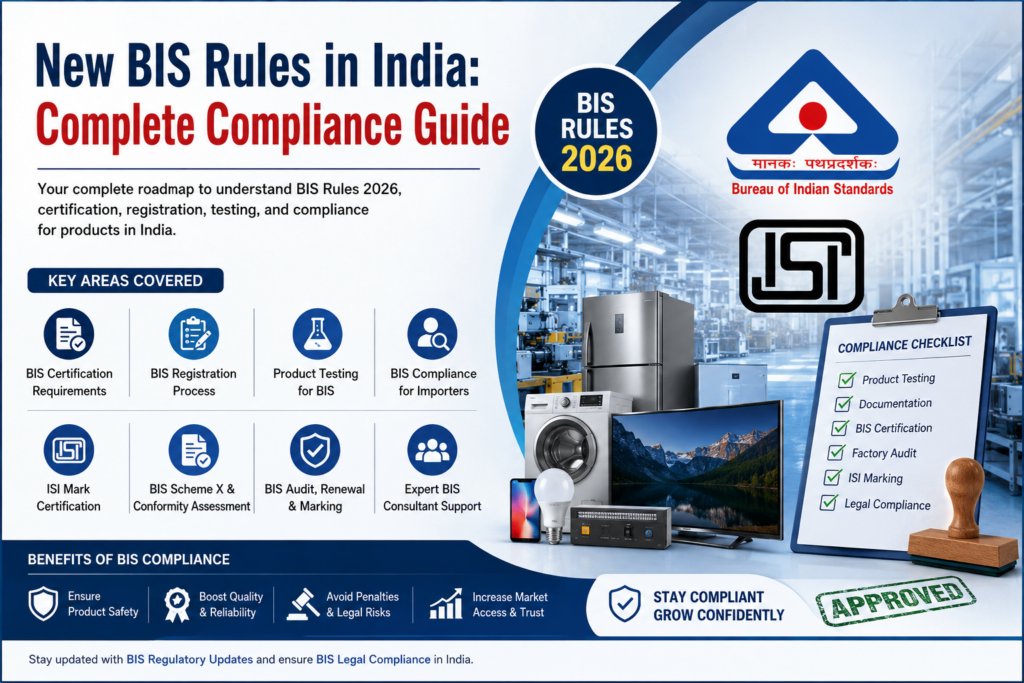
India’s product quality and safety regulations are becoming more comprehensive every year. Businesses involved in manufacturing, importing, and distributing products must understand the latest compliance requirements to avoid legal complications and maintain uninterrupted market access. This New BIS Rules in India: Complete Compliance Guide provides a detailed overview of recent changes introduced under BIS Rules 2026 and explains how organizations can achieve full regulatory compliance.
The Bureau of Indian Standards Compliance framework is responsible for ensuring that products sold in India meet prescribed quality, safety, and performance standards. As the government expands certification coverage across various sectors, businesses must stay informed and proactive.
What Are the New BIS Rules in India?
The New BIS Rules in India: Complete Compliance Guide helps businesses understand the latest regulatory developments affecting product certification and quality assurance. These rules are intended to strengthen consumer protection, improve manufacturing standards, and promote consistency across industries.
The recent BIS Standards Update 2026 has introduced additional compliance obligations for manufacturers and importers, particularly in sectors such as electronics, industrial products, construction materials, and consumer goods.
Companies that fail to comply with updated regulations may face penalties, product recalls, or restrictions on market access.
Importance of BIS Certification India
Obtaining BIS Certification India demonstrates that a product complies with applicable Indian standards and regulatory requirements.
Key advantages include:
- Improved customer confidence
- Enhanced product credibility
- Legal market access
- Better brand reputation
- Reduced compliance risks
The New BIS Rules in India: Complete Compliance Guide emphasizes that certification is increasingly important as more product categories fall under Mandatory BIS Certification requirements.
BIS Registration Process: Step-by-Step
The BIS Registration Process involves several stages that ensure products comply with national standards.
Step 1: Product Classification
Identify applicable standards and certification schemes.
Step 2: Product Testing for BIS
Products must be tested at recognized laboratories to verify compliance.
Step 3: Documentation Preparation
Prepare all required BIS Compliance Documentation and technical records.
Step 4: BIS License Application
Submit applications along with test reports and supporting documents.
Step 5: Evaluation and Approval
BIS reviews the application and issues certification upon successful assessment.
Following the New BIS Rules in India: Complete Compliance Guide can help businesses avoid delays and improve approval efficiency.
BIS Certification Requirements
Meeting BIS Certification Requirements is essential for obtaining approval.
Typical requirements include:
- Company registration documents
- Product specifications
- Manufacturing details
- Quality management procedures
- Laboratory test reports
- Compliance declarations
Accurate documentation and proper preparation significantly improve certification outcomes.
BIS Compliance for Importers
Foreign manufacturers and importers must comply with all applicable Indian regulations before introducing products into the market.
BIS Compliance for Importers includes:
- Product testing
- Certification approval
- Labeling compliance
- Technical documentation
- Ongoing regulatory maintenance
The New BIS Rules in India: Complete Compliance Guide explains that importers are equally responsible for ensuring compliance with applicable standards.
BIS Certification for Electronics and CRS Registration
The electronics sector remains one of the most heavily regulated industries under BIS.
BIS Certification for Electronics commonly applies to:
- Smartphones
- Computers
- Power adapters
- LED lighting products
- Smart devices
- Electronic accessories
Most of these products require BIS CRS Registration before being sold in India.
Businesses should regularly monitor BIS Regulatory Updates to remain compliant with changing requirements.
BIS Scheme X and Conformity Assessment
The introduction of BIS Scheme X has strengthened compliance obligations for various industrial products. The scheme focuses on enhanced BIS Conformity Assessment procedures and improved quality verification.
Manufacturers must evaluate whether their products fall within the scope of newly regulated categories and ensure timely certification.
The New BIS Rules in India: Complete Compliance Guide recommends conducting periodic compliance reviews to minimize regulatory risks.
BIS Audit Requirements and Certification Renewal
Obtaining certification is only the beginning. Businesses must continue meeting BIS Audit Requirements and complete BIS Certification Renewal procedures as required.
Audits typically evaluate:
- Manufacturing consistency
- Product quality
- Compliance documentation
- Quality management systems
- Certification marking practices
Regular compliance monitoring helps businesses maintain certification validity.
BIS Marking Requirements and ISI Mark Certification
Certified products must follow specific BIS Marking Requirements to demonstrate compliance.
For many products, ISI Mark Certification serves as an official indication that the product meets prescribed Indian standards.
Incorrect labeling or misuse of certification marks may result in regulatory action and financial penalties.
Professional BIS Compliance Support
Managing certification requirements can be challenging, especially for organizations dealing with multiple products and changing regulations. Professional BIS Certification Consultants provide valuable support throughout the certification lifecycle.
Organizations such as Council of Compliances assist businesses with certification planning, testing coordination, documentation preparation, audit support, and regulatory compliance management.
By following the New BIS Rules in India: Complete Compliance Guide, businesses can achieve complete BIS Legal Compliance India, reduce regulatory risks, and build stronger market credibility.
FAQs
1. What is BIS Certification India?
BIS Certification India confirms that a product complies with applicable Indian quality and safety standards.
2. What are the New BIS Rules in India?
They are updated regulations introduced to strengthen product quality, safety, testing, and certification requirements.
3. Is BIS certification mandatory for all products?
No, but many products are covered under Mandatory BIS Certification schemes and require approval before sale.
4. What is BIS CRS Registration?
It is the Compulsory Registration Scheme applicable to various electronic and IT products.
5. What is BIS Scheme X?
BIS Scheme X is a certification framework designed for selected industrial products requiring enhanced conformity assessment.
6. Why is Product Testing for BIS important?
Testing verifies product compliance with applicable standards before certification approval.
7. What are BIS Audit Requirements?
Audits ensure ongoing compliance with quality standards, manufacturing controls, and certification conditions.
8. How can BIS Certification Consultants help?
They assist with documentation, testing, registration, audits, renewals, and overall compliance management.