
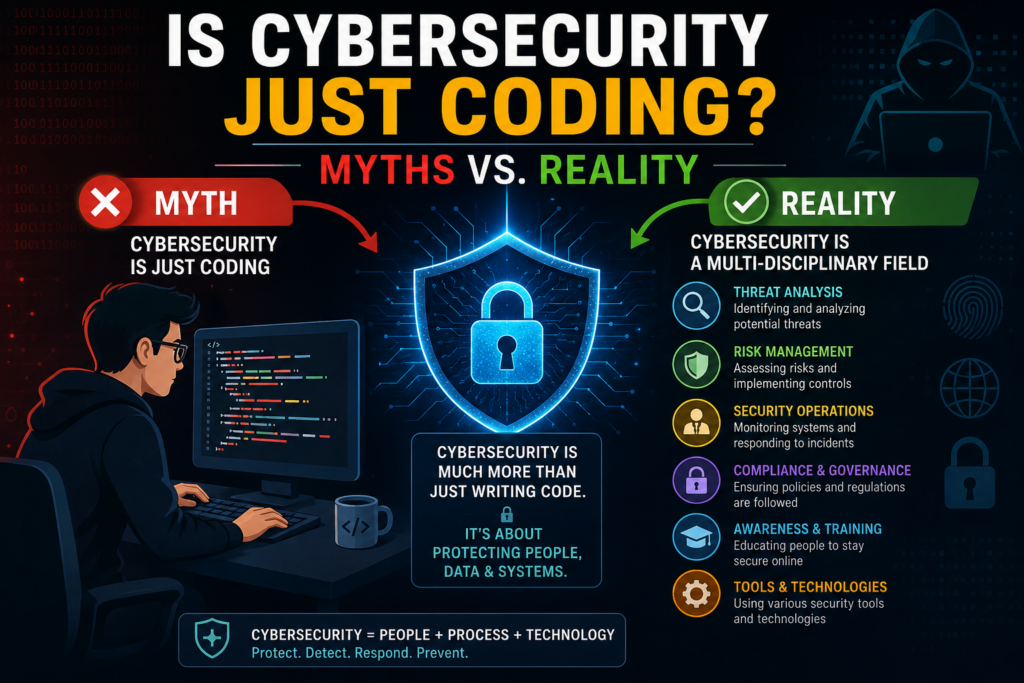
As organizations continue to digitize their operations, cybersecurity has become a critical business requirement. From protecting customer information to preventing data breaches, cybersecurity professionals play a vital role in maintaining secure digital environments. However, a common misconception persists among students and job seekers: cybersecurity is only about coding. This misunderstanding often prevents talented individuals from exploring a rewarding and rapidly growing industry.At councilofcompliances, we frequently help professionals understand the true scope of cybersecurity and the wide range of opportunities available. To answer the question “Is cybersecurity just coding? Myths vs. Reality”, it is important to examine what cybersecurity professionals actually do and why coding is only one part of a much larger field.
Understanding Is cybersecurity just coding? Myths vs. Reality can help aspiring professionals make informed career choices and develop the right skills for long-term success.
Breaking the Biggest Cybersecurity Myth
One of the most common Cybersecurity Myths and Facts discussions revolves around programming requirements.
Many people assume that cybersecurity professionals spend all day writing code. While some specialized roles involve scripting and programming, the majority of cybersecurity work focuses on protecting systems, managing risks, detecting threats, and responding to incidents.
Security professionals often use existing tools, platforms, and frameworks to secure digital environments rather than developing software from scratch.
This practical reality is central to understanding Is cybersecurity just coding? Myths vs. Reality.
Cybersecurity vs Coding: Understanding Their Roles
The comparison between Cybersecurity vs Coding is often misunderstood because both fields operate within the technology sector.
Coding focuses on creating applications, websites, databases, and software systems. Cybersecurity focuses on protecting those systems from unauthorized access, cyberattacks, and vulnerabilities.
Developers build technology, while cybersecurity professionals defend it.
Recognizing this distinction makes it easier to understand Is cybersecurity just coding? Myths vs. Reality and the unique value cybersecurity brings to organizations.
Essential Cybersecurity Skills Required
Cybersecurity professionals rely on a wide variety of skills beyond programming.
Important Cybersecurity Skills Required include:
- Risk assessment
- Security monitoring
- Threat analysis
- Communication
- Incident response
- Compliance management
- Network security knowledge
- Security auditing
- Problem-solving
- Data Protection and Security expertise
These competencies are often more important than coding for many cybersecurity positions.
This reinforces the truth behind Is cybersecurity just coding? Myths vs. Reality.
Cybersecurity Without Coding Is Possible
The concept of Cybersecurity Without Coding is becoming increasingly popular because many organizations need professionals in non-programming security roles.
Examples include:
- Security Analyst Career positions
- Governance specialists
- Compliance managers
- Security auditors
- Cybersecurity Awareness coordinators
- Risk management consultants
These careers focus on protecting organizations through analysis, planning, and policy implementation rather than software development.
As a result, the answer to Is cybersecurity just coding? Myths vs. Reality becomes much clearer.
Importance of Information Security Solutions
Businesses rely on advanced Information Security Solutions to protect valuable data and maintain operational continuity.
Key security functions include:
- Data Protection and Security management
- Threat detection
- Vulnerability assessments
- Access control systems
- Incident response planning
- Cyber Threat Prevention programs
Professionals managing these initiatives often work with security tools and frameworks rather than writing code.
This demonstrates another aspect of Is cybersecurity just coding? Myths vs. Reality.
Ethical Hacking Services and Security Assessments
Many people associate cybersecurity with hackers writing complex code. While Ethical Hacking Services may involve technical testing, successful ethical hackers also depend on:
- Research abilities
- Security methodologies
- Network analysis
- Vulnerability assessments
- Detailed reporting
Their role is to identify weaknesses before malicious attackers can exploit them.
This broader perspective further explains Is cybersecurity just coding? Myths vs. Reality.
Growing Cybersecurity Career Opportunities
A detailed Cybersecurity Career Guide reveals a wide variety of professional pathways.
Popular Cybersecurity Career Opportunities include:
- Security Analyst Career professional
- Threat Intelligence Analyst
- Compliance Officer
- Security Consultant
- Incident Response Specialist
- Network Security Management expert
- Governance and Risk Manager
- Security Operations Center Analyst
The diversity of these positions shows that cybersecurity welcomes individuals with different educational backgrounds and skill sets.
This is another reason why Is cybersecurity just coding? Myths vs. Reality remains an important conversation.
Modern Cybersecurity Practices
Organizations today implement advanced Modern Cybersecurity Practices to defend against evolving threats.
These practices include:
- Security awareness programs
- Cloud security strategies
- Continuous monitoring
- Multi-factor authentication
- Threat intelligence analysis
- Vulnerability management
- Incident response planning
- Digital Security Solutions implementation
Many cybersecurity professionals focus on managing and optimizing these systems rather than writing software.
This reality strengthens the understanding of Is cybersecurity just coding? Myths vs. Reality.
Cybersecurity for Beginners
For those exploring Cybersecurity for Beginners, the field offers numerous learning opportunities through professional Cybersecurity Training programs.
Beginners typically learn:
- Security fundamentals
- Networking basics
- Threat management
- Security operations
- Risk assessment
- IT Security Services concepts
These foundational areas provide an accessible entry point into cybersecurity, even for individuals with limited coding experience.
Therefore, Is cybersecurity just coding? Myths vs. Reality should not discourage motivated learners from pursuing cybersecurity careers.
Conclusion
The answer to Is cybersecurity just coding? Myths vs. Reality is simple: cybersecurity is much more than programming. While coding skills can be valuable in specialized technical roles, many cybersecurity careers focus on governance, monitoring, compliance, risk management, and security operations.
As organizations continue investing in Information Security Solutions, Network Security Management, IT Security Services, and Cyber Threat Prevention, the demand for skilled cybersecurity professionals continues to rise. Whether you come from a technical or non-technical background, cybersecurity offers diverse opportunities for growth and long-term career success.
Frequently Asked Questions (FAQs)
1. Is cybersecurity only about coding?
No. Cybersecurity includes threat management, compliance, governance, monitoring, and risk assessment in addition to coding.
2. Can I work in cybersecurity without programming?
Yes. Many cybersecurity roles focus on security operations, auditing, compliance, and awareness rather than coding.
3. What is the difference between cybersecurity and coding?
Coding develops software, while cybersecurity protects systems, networks, and data from threats.
4. What are the most important cybersecurity skills?
Risk assessment, communication, security monitoring, threat analysis, and incident response are essential skills.
5. Is ethical hacking purely programming-based?
No. Ethical hacking also requires research, vulnerability assessment, network analysis, and reporting skills.
6. What are some beginner-friendly cybersecurity careers?
Security analyst, compliance assistant, governance specialist, and SOC analyst are common entry-level roles.
7. Does cybersecurity offer strong career growth?
Yes. Cybersecurity remains one of the fastest-growing technology sectors worldwide.
8. What is network security management?
It involves protecting network infrastructure from cyberattacks, unauthorized access, and security vulnerabilities.
9. How can beginners learn cybersecurity?
Through cybersecurity training, certifications, hands-on labs, networking fundamentals, and security awareness programs.
10. Why is cybersecurity important for organizations?
Cybersecurity protects sensitive data, prevents financial losses, ensures compliance, and maintains customer trust.