
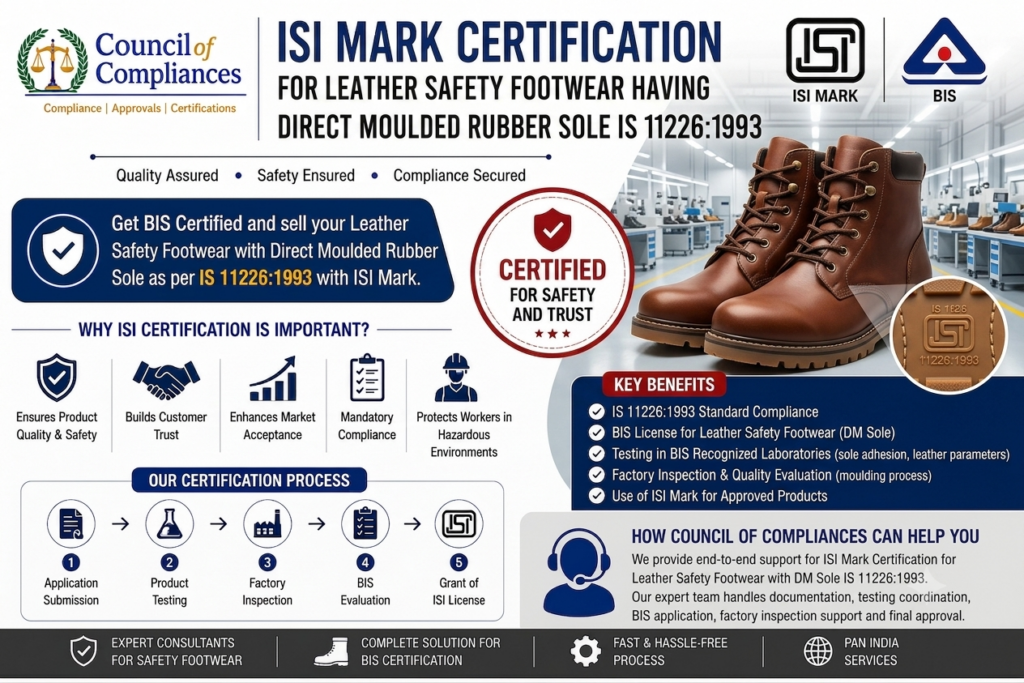
Safety footwear plays a critical role in protecting workers from workplace hazards in industries such as construction, manufacturing, engineering, logistics, and heavy machinery operations. To ensure product quality and safety, manufacturers must obtain ISI Mark Certification for Leather Safety Footwear Having Direct Moulded Rubber Sole IS 11226:1993 in accordance with the requirements established by the Bureau of Indian Standards (BIS).
The ISI Mark Certification for Leather Safety Footwear Having Direct Moulded Rubber Sole IS 11226:1993 confirms that the product complies with the specifications of IS 11226:1993 and meets prescribed performance, durability, and safety requirements. This certification helps manufacturers gain market recognition while assuring buyers of product reliability.
For businesses involved in manufacturing protective footwear, obtaining ISI Mark Certification for Leather Safety Footwear Having Direct Moulded Rubber Sole IS 11226:1993 is a significant step toward quality assurance and regulatory compliance.
Understanding IS 11226:1993 Compliance
The IS 11226:1993 Certification standard applies to leather safety footwear featuring direct moulded rubber soles. These footwear products are specifically designed to provide protection in industrial and hazardous working environments.
Through ISI Certification for Leather Safety Footwear, manufacturers demonstrate adherence to nationally recognized quality standards. Compliance with the standard ensures that products are manufactured using approved processes and are capable of delivering the expected level of safety and performance.
The ISI Mark Certification for Leather Safety Footwear Having Direct Moulded Rubber Sole IS 11226:1993 also helps manufacturers strengthen customer confidence and improve product acceptance across various sectors.
Benefits of BIS Certification
Obtaining BIS Certification for Leather Safety Shoes offers multiple benefits, including:
- Compliance with Indian quality standards
- Improved product reputation
- Increased customer trust
- Better access to industrial buyers
- Enhanced brand value
- Competitive market advantage
- Eligibility for institutional procurement
The Direct Moulded Rubber Sole Footwear Certification assures customers that the footwear has been evaluated and approved according to established quality requirements.
BIS Certification Process
Manufacturers seeking ISI Mark Certification for Leather Safety Footwear Having Direct Moulded Rubber Sole IS 11226:1993 generally follow the process outlined below:
Application Submission
The manufacturer submits an application to BIS along with relevant documents and technical information.
Product Testing
Product samples undergo testing at approved laboratories to verify IS 11226:1993 Compliance.
Factory Inspection
BIS officials inspect manufacturing facilities to evaluate production systems and quality control measures.
License Grant
Upon successful assessment, BIS issues the ISI Mark License for Leather Safety Footwear.
Ongoing Surveillance
Periodic inspections and sample testing help ensure continuous compliance with certification requirements.
Required Documentation
Manufacturers applying for BIS License for Safety Footwear generally need:
- Business registration certificates
- Factory license
- Product specifications
- Manufacturing process details
- Quality assurance records
- Test reports
- Authorized signatory documents
Accurate documentation significantly improves the efficiency of the certification process.
Importance of Product Testing
Leather Safety Footwear Testing and Certification is a crucial part of obtaining BIS approval. Testing verifies that footwear products satisfy performance and safety requirements specified under the standard.
Through Safety Footwear Quality Certification, manufacturers can demonstrate product consistency and reliability. Proper testing also supports successful certification and ongoing compliance.
The ISI Mark Certification for Leather Safety Footwear Having Direct Moulded Rubber Sole IS 11226:1993 ensures that footwear products are capable of delivering effective protection under industrial working conditions.
Why Choose Councilofcompliances?
Councilofcompliances provides professional consultancy services for ISI Mark Certification for Leather Safety Footwear Having Direct Moulded Rubber Sole IS 11226:1993. Their experienced consultants assist manufacturers throughout the certification journey, including application preparation, documentation review, testing coordination, and factory inspection support.
As a trusted BIS Consultant for IS 11226:1993, Councilofcompliances helps businesses achieve compliance efficiently while minimizing delays and regulatory challenges. Their comprehensive services support manufacturers seeking BIS Approval for Leather Safety Footwear and related certifications.
Whether your organization requires ISI Mark for Industrial Safety Shoes, Safety Footwear Certification India, or guidance regarding Direct Moulded Sole Safety Footwear, Councilofcompliances offers complete compliance solutions.
Conclusion
The ISI Mark Certification for Leather Safety Footwear Having Direct Moulded Rubber Sole IS 11226:1993 is an important certification for manufacturers committed to delivering safe, durable, and compliant footwear products. It enhances product credibility, supports regulatory compliance, and improves business opportunities.
By obtaining ISI Mark Certification for Leather Safety Footwear Having Direct Moulded Rubber Sole IS 11226:1993, manufacturers can establish trust with customers, strengthen their market presence, and demonstrate their commitment to quality and workplace safety.
FAQs
1. What is ISI Mark Certification for Leather Safety Footwear Having Direct Moulded Rubber Sole IS 11226:1993?
It is a BIS certification confirming that leather safety footwear complies with IS 11226:1993 quality and safety requirements.
2. Why is IS 11226:1993 important?
The standard ensures that safety footwear provides reliable protection, durability, and performance.
3. Who can apply for certification?
Manufacturers producing leather safety footwear with direct moulded rubber soles can apply.
4. Is testing required for certification?
Yes, BIS-approved laboratory testing is a mandatory part of the certification process.
5. What documents are needed for BIS certification?
Applicants generally require company documents, manufacturing details, quality records, and test reports.
6. How long does the certification process take?
The timeline varies depending on documentation, testing, factory inspection, and BIS review.
7. Can a consultant help with certification?
Yes, professional consultants provide end-to-end support for documentation, testing, audits, and BIS approvals.