
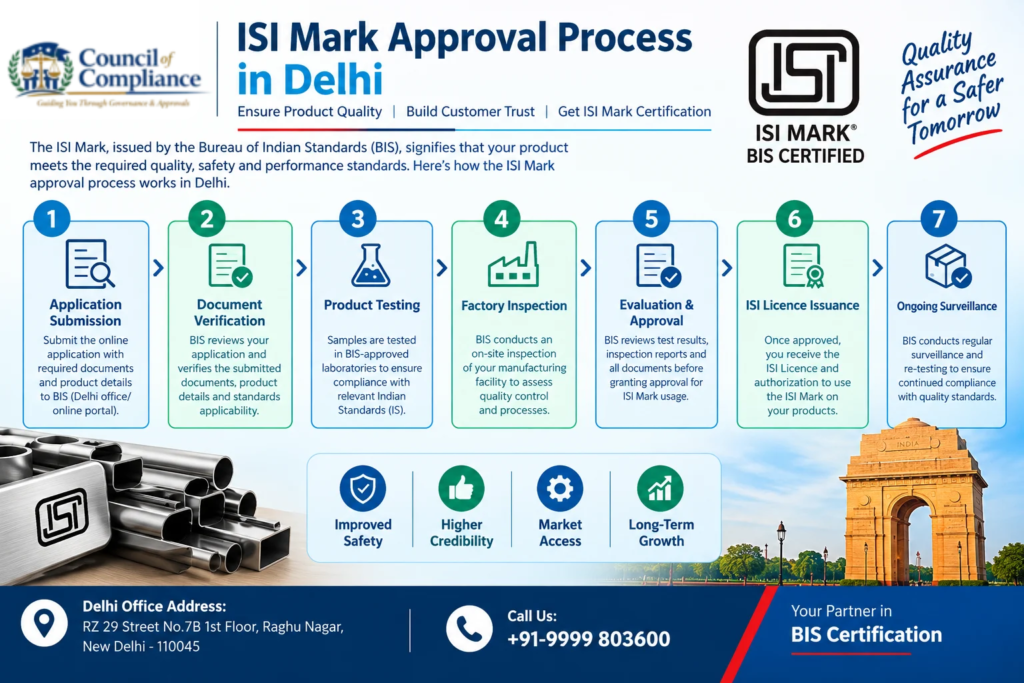
For manufacturers of products covered by mandatory BIS requirements, obtaining an ISI mark is an important part of regulatory compliance. The ISI Mark Approval Process in Delhi involves several stages, including identifying the applicable Indian Standard, product testing, documentation, factory assessment, and BIS license issuance.
At councilofcompliances, businesses can receive structured assistance throughout the certification journey. Professional guidance can help manufacturers understand applicable requirements, organize documentation, coordinate testing, and prepare for BIS inspections.
What Is ISI Mark Certification?
The ISI mark indicates that a certified product conforms to the applicable Indian Standard under the BIS certification framework. Depending on the product category, manufacturers may need to fulfill specific technical, testing, quality-control, and inspection requirements.
The ISI Mark Approval Process in Delhi should therefore begin with determining whether the product is covered by a mandatory certification requirement and identifying the correct standard.
Steps in the ISI Certification Process
1. Identify the Applicable Standard
The first stage of the ISI Certification Process Delhi is identifying the Indian Standard relevant to the product. Different products can have different specifications, testing parameters, and certification requirements.
2. Prepare Required Documents
Manufacturers need appropriate ISI Mark Documentation Delhi, which may include:
- Manufacturing process information
- Product specifications
- Factory registration details
- Machinery information
- Quality-control procedures
- Test-related documents
- Technical records
Correct documentation helps avoid unnecessary queries during application processing.
3. Complete Product Testing
Product testing is a key component of ISI Mark Testing Requirements Delhi. Samples may need to be tested through laboratories recognized or accepted under the applicable BIS requirements.
The testing process evaluates whether the product meets relevant technical specifications.
4. Submit the BIS Application
After preparing the required information, the manufacturer submits the application and supporting documents. The ISI Mark Application Process Delhi requires accurate product and manufacturing details.
5. Factory Inspection
BIS may conduct a factory assessment to verify manufacturing capabilities, quality-control arrangements, production processes, and testing facilities.
Preparing properly for an ISI Mark Audit Delhi can help manufacturers address compliance requirements systematically.
6. Grant of License
After successful completion of applicable testing, documentation review, and inspection requirements, BIS may grant the certification license. This completes the applicable ISI Mark Approval Process in Delhi.
Why Professional Assistance Matters
BIS certification can involve technical standards, laboratory testing, documentation, and regulatory communication. An ISI Mark Consultant Delhi can assist businesses with these activities and help organize the certification process.
Businesses may seek assistance for:
- BIS ISI Mark Approval Delhi
- ISI Mark Registration Delhi
- BIS Certification Delhi
- BIS License Registration Delhi
- Product Certification Delhi
- ISI Mark Compliance Delhi
- ISI Mark Approval Services Delhi
Professional assistance can make the ISI Mark Approval Process in Delhi easier to manage, particularly for manufacturers unfamiliar with BIS procedures.
ISI Mark Certification for Manufacturers
The ISI Mark for Manufacturers Delhi is relevant to businesses producing products subject to mandatory BIS certification. Manufacturers must maintain appropriate production and quality-control systems to support ongoing compliance.
For companies introducing a new product, expanding production, or entering regulated markets, understanding the ISI Mark Approval Process in Delhi before beginning the application can help with planning.
Support for Importers and Businesses
Depending on the applicable product regulations, businesses involved in importing regulated products may also need to understand requirements relating to ISI Mark for Importers Delhi.
Businesses can also seek guidance regarding BIS ISI Registration Delhi, BIS ISI Certification Services Delhi, and related compliance obligations before bringing products into the Indian market.
Why Choose councilofcompliances?
At councilofcompliances, compliance professionals assist businesses with certification-related requirements, including documentation, testing coordination, application support, and audit preparation.
The objective is to provide a structured approach to the ISI Mark Approval Process in Delhi, helping clients understand each stage and prepare the required information.
Businesses looking for an ISI Approval Consultant Delhi, BIS Consultant Delhi, or ISI Certification Agency Delhi can benefit from professional assistance tailored to their product category and applicable BIS requirements.
With proper preparation, businesses can approach certification requirements systematically and maintain compliance after receiving the license.
FAQs
1. What is the ISI Mark Approval Process in Delhi?
It is the procedure for obtaining BIS authorization to use the ISI mark on products covered by applicable certification requirements.
2. Is ISI certification mandatory for every product?
No. Mandatory certification applies to specific products and categories notified under applicable regulations.
3. What are the main stages of ISI certification?
The process generally involves standard identification, documentation, product testing, application submission, factory assessment, and certification.
4. Why is product testing required?
Testing helps determine whether the product meets the technical requirements of the applicable Indian Standard.
5. What happens during a BIS factory inspection?
BIS assesses relevant manufacturing processes, quality controls, facilities, and testing arrangements.
6. Can a consultant assist with BIS documentation?
Yes. Consultants can help organize technical and supporting documents and coordinate various certification activities.
7. How can manufacturers maintain ISI compliance?
Manufacturers should follow applicable standards, maintain quality-control systems, comply with BIS conditions, and complete required surveillance or renewal activities.