
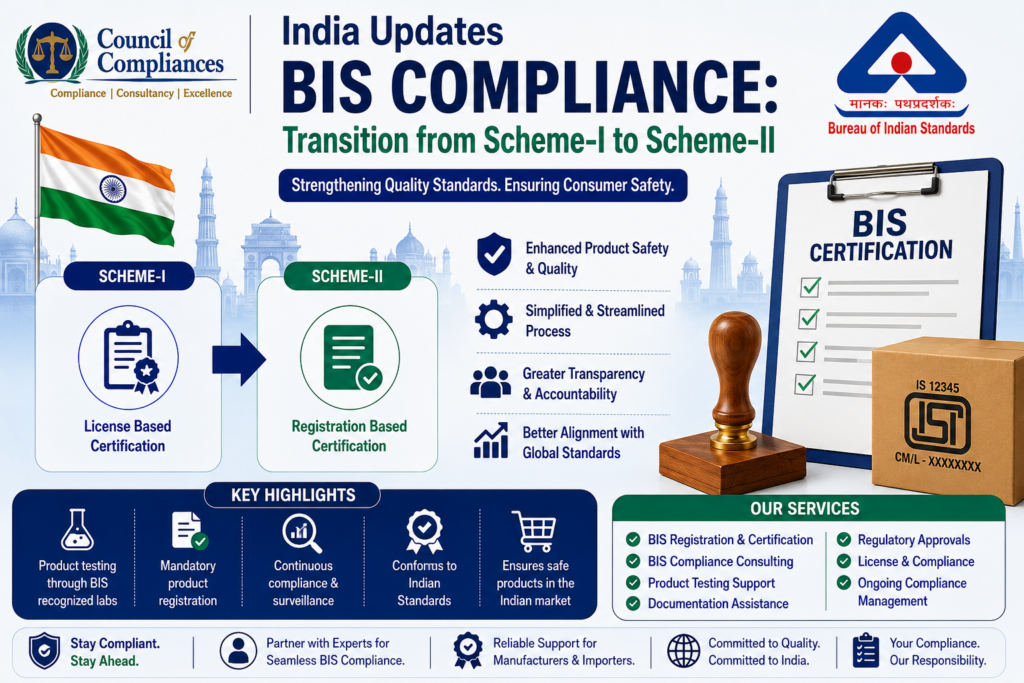
India’s quality and product certification ecosystem is undergoing a major transformation with India Updates BIS Compliance: Transition from Scheme-I to Scheme-II. This regulatory shift is designed to strengthen product quality standards, improve conformity assessment procedures, and create a more efficient certification framework for manufacturers and importers. 🇮🇳
As industries continue to expand and consumer expectations rise, the Bureau of Indian Standards Compliance system is evolving to ensure that products sold in India meet the highest standards of safety and quality. The BIS Scheme-I to Scheme-II Transition is a significant step in achieving these objectives.
At councilofcompliances, we assist businesses in understanding regulatory obligations and successfully managing certification requirements under the latest BIS framework. 🚀
Overview of the BIS Compliance Update India
The recent BIS Compliance Update India reflects the government’s ongoing efforts to modernize product certification processes and strengthen regulatory oversight. Businesses that manufacture, import, or distribute regulated products must understand how these changes affect their compliance responsibilities.
The purpose of India Updates BIS Compliance: Transition from Scheme-I to Scheme-II is to streamline certification procedures while maintaining strict quality assurance standards. This transition helps improve transparency, efficiency, and product reliability across various industries.
Key goals include:
✅ Enhancing consumer protection
✅ Improving product quality
✅ Strengthening conformity assessment
✅ Simplifying certification procedures
✅ Supporting industrial growth and innovation
Companies that fail to adapt to these changes may encounter delays, penalties, or restrictions in market access.
Understanding the BIS Scheme-I to Scheme-II Transition
The BIS Scheme-I to Scheme-II Transition involves moving certain product categories from a traditional licensing framework to a registration-based certification system.
Under Scheme-I:
📋 Manufacturers obtain BIS licenses.
📋 Factory inspections are typically required.
📋 Compliance verification is conducted before licensing.
Under Scheme-II:
📋 Product registration becomes mandatory.
📋 Testing through BIS-recognized laboratories is required.
📋 Technical documentation must be submitted.
📋 Ongoing compliance monitoring continues after registration.
The India Updates BIS Compliance: Transition from Scheme-I to Scheme-II initiative is intended to improve efficiency while ensuring continued compliance with Indian Standards.
BIS Certification Requirements India
Manufacturers must understand the updated BIS Certification Requirements India to maintain uninterrupted access to the Indian market.
Important requirements include:
🔹 Product testing and evaluation
🔹 Technical documentation preparation
🔹 Registration application filing
🔹 Product labeling compliance
🔹 Conformity declarations
🔹 Ongoing surveillance obligations
These requirements form the foundation of effective BIS Regulatory Compliance India and help ensure product consistency and safety.
Organizations affected by India Updates BIS Compliance: Transition from Scheme-I to Scheme-II should begin reviewing their compliance programs immediately.
BIS Regulatory Changes 2026
The upcoming BIS Regulatory Changes 2026 are expected to further strengthen India’s certification ecosystem and improve regulatory efficiency. ⚙️
Key areas of focus include:
🌟 Enhanced conformity assessment systems
🌟 Stronger product monitoring mechanisms
🌟 Improved testing requirements
🌟 Greater alignment with international standards
🌟 Increased regulatory transparency
These developments will support the long-term objectives of BIS Mandatory Certification India and improve confidence among consumers and businesses alike.
BIS Product Certification Scheme-II Process
The BIS Product Certification Scheme-II follows a systematic process that helps verify compliance with applicable Indian Standards.
Step 1: Product Testing 🧪
Products are tested in BIS-recognized laboratories to ensure conformity with relevant standards.
Step 2: Documentation Compilation 📄
Manufacturers prepare technical files, declarations, and compliance documents.
Step 3: Application Submission 📝
Registration applications are submitted along with supporting evidence.
Step 4: BIS Evaluation ✔️
Authorities review the application and assess compliance requirements.
Step 5: Registration Approval 🚀
Successful applicants receive registration approval for product sale in India.
This process ensures effective Product Certification under Scheme-II while maintaining regulatory integrity.
Challenges in BIS Scheme-I Certification Migration
The BIS Scheme-I Certification Migration process can create several operational and administrative challenges for businesses.
Common challenges include:
⚠️ Understanding revised regulations
⚠️ Managing documentation requirements
⚠️ Coordinating laboratory testing
⚠️ Monitoring compliance deadlines
⚠️ Maintaining ongoing conformity
Professional guidance can help organizations navigate the complexities associated with India Updates BIS Compliance: Transition from Scheme-I to Scheme-II.
Importance of BIS Compliance Consulting India
Expert BIS Compliance Consulting India services provide valuable support throughout the certification lifecycle.
Benefits include:
🎯 Faster regulatory approvals
🎯 Reduced compliance risks
🎯 Improved documentation accuracy
🎯 Better project coordination
🎯 Enhanced regulatory understanding
🎯 Ongoing compliance support
These services help businesses adapt efficiently to the latest BIS Standards and Regulations Update requirements.
How councilofcompliances Supports Businesses
At councilofcompliances, we provide comprehensive BIS Registration and Certification Services designed to simplify the certification journey for manufacturers and importers. 🌟
Our services include:
- BIS certification assistance
- Product registration support
- Documentation review
- Compliance audits
- Regulatory consulting
- Testing coordination
- Post-certification support
Our experienced team helps businesses comply with BIS Licensing and Compliance Services requirements and achieve successful certification outcomes.
Benefits of Early Compliance Planning
Organizations that proactively prepare for India Updates BIS Compliance: Transition from Scheme-I to Scheme-II gain numerous advantages.
🏆 Faster certification approvals
🏆 Reduced business disruptions
🏆 Improved market access
🏆 Stronger brand reputation
🏆 Increased customer confidence
🏆 Better compliance readiness
🏆 Sustainable long-term growth
Early action allows businesses to adapt efficiently and avoid last-minute compliance challenges.
Conclusion
The India Updates BIS Compliance: Transition from Scheme-I to Scheme-II initiative represents an important advancement in India’s quality assurance and certification framework. As regulatory expectations continue to evolve, businesses must remain informed and proactive in managing their certification obligations.
By utilizing professional BIS Registration and Certification Services and expert regulatory guidance, organizations can successfully navigate the BIS Conformity Assessment Scheme-II and maintain compliance with all applicable requirements.
With support from councilofcompliances, manufacturers can confidently manage the Indian Standards Certification Update, achieve full BIS Regulatory Compliance India, and continue growing in an increasingly competitive marketplace. 🚀
The India Updates BIS Compliance: Transition from Scheme-I to Scheme-II is more than a regulatory change—it is an opportunity to strengthen quality systems, improve consumer trust, and support long-term business success.
Frequently Asked Questions (FAQs)
1. What is India Updates BIS Compliance: Transition from Scheme-I to Scheme-II?
It is a regulatory change where selected products move from BIS licensing under Scheme-I to registration-based compliance under Scheme-II.
2. Why has BIS introduced this transition?
The transition aims to improve product quality, enhance consumer safety, and strengthen conformity assessment procedures.
3. Who must comply with the BIS Compliance Update India?
Manufacturers, importers, distributors, and businesses dealing with regulated products in India.
4. What are the major BIS Certification Requirements India?
Requirements include product testing, technical documentation, registration applications, and ongoing compliance monitoring.
5. What is BIS Product Certification Scheme-II?
It is a registration-based conformity assessment system used to verify compliance with Indian Standards.
6. How can BIS Compliance Consulting India help businesses?
Consultants provide assistance with testing, documentation, registration, and ongoing regulatory compliance.
7. Why choose councilofcompliances for BIS certification support?
councilofcompliances offers expert consulting, certification assistance, compliance management, and end-to-end regulatory support services.