
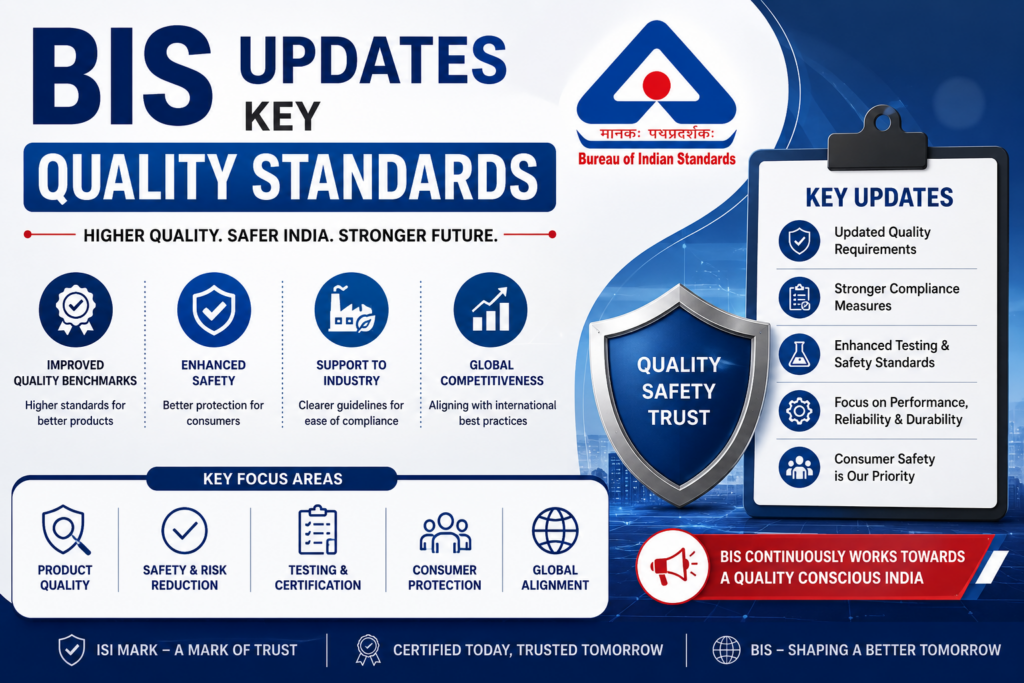
India’s regulatory landscape is continuously evolving to support higher product quality, enhanced consumer protection, and stronger manufacturing standards. In a major development for businesses across various sectors, BIS Updates Key Quality Standards to ensure products manufactured, imported, and sold in India meet modern safety and performance expectations BIS Updates Key Quality Standards.
These revisions impact manufacturers, importers, exporters, distributors, and certification holders who must align their operations with the latest regulatory requirements. At councilofcompliances, we help businesses understand and implement these changes efficiently while maintaining uninterrupted compliance with applicable BIS regulations.
Why BIS Updates Key Quality Standards Regularly
The Bureau of Indian Standards serves as India’s national standardization body and is responsible for creating and maintaining product quality benchmarks. Whenever BIS Updates Key Quality Standards, the objective is to address technological advancements, market developments, safety concerns, and global best practices.
The latest BIS Quality Standards Update focuses on:
- Improved product safety requirements
- Enhanced performance benchmarks
- Modernized testing procedures
- Better quality assurance mechanisms
- Stronger conformity assessment systems
These improvements contribute to a more reliable and competitive manufacturing ecosystem in India.
Understanding the Latest BIS Regulatory Developments
The recent Bureau of Indian Standards Latest Updates affect a broad range of industries including electronics, electrical equipment, consumer products, industrial machinery, construction materials, and household goods.
As BIS Updates Key Quality Standards, businesses are required to review:
- Product specifications
- Manufacturing processes
- Testing procedures
- Certification documentation
- Quality management systems
Failure to comply with revised standards may lead to certification delays, regulatory actions, or market access restrictions.
Updated BIS Certification Requirements
One of the most significant outcomes when BIS Updates Key Quality Standards is the revision of certification procedures.
The latest BIS Certification Requirements emphasize:
Enhanced Product Testing
Manufacturers must comply with updated BIS Product Testing Standards before obtaining or renewing certification.
Improved Documentation Standards
Organizations are expected to maintain comprehensive records supporting compliance with Updated BIS Compliance Standards.
Factory Quality Controls
The revised framework places greater importance on manufacturing consistency and quality management systems.
Surveillance and Monitoring
Certified organizations may be subject to periodic assessments to verify continued compliance with BIS Quality Assurance Standards.
Impact on Manufacturing Businesses
The latest BIS Manufacturing Compliance Standards require businesses to strengthen their internal quality controls and production practices.
When BIS Updates Key Quality Standards, manufacturers should evaluate:
- Product design specifications
- Production workflows
- Supplier quality management
- Internal testing procedures
- Certification validity
These proactive measures help ensure continued compliance and reduce operational risks.
Mandatory Certification and Quality Control Orders
The government has increasingly introduced mandatory certification requirements through Quality Control Orders (QCOs).
The revised BIS Quality Control Order India framework aims to:
- Eliminate substandard products
- Improve consumer safety
- Promote quality manufacturing
- Strengthen market surveillance
Businesses covered under these regulations must closely monitor Mandatory BIS Certification Updates to ensure ongoing compliance.
As BIS Updates Key Quality Standards, additional product categories may also become subject to mandatory certification requirements.
Product Safety and Performance Standards
Product quality is no longer limited to basic compliance. Today’s standards emphasize overall product performance, durability, reliability, and consumer safety.
The revised BIS Safety and Performance Standards help ensure that products consistently meet expected benchmarks throughout their lifecycle.
Benefits include:
- Improved customer satisfaction
- Reduced product failures
- Stronger brand reputation
- Enhanced market credibility
- Better export readiness
Organizations complying with the latest BIS Product Quality Standards are better positioned to compete in domestic and international markets.
Compliance Strategies for Businesses
To successfully adapt whenever BIS Updates Key Quality Standards, businesses should adopt a structured compliance strategy.
Recommended steps include:
Conduct Compliance Reviews
Assess current certifications and identify any gaps against revised requirements.
Update Quality Systems
Align internal procedures with the latest BIS Quality Management Standards.
Strengthen Documentation
Maintain accurate records supporting certification and compliance activities.
Coordinate Product Testing
Ensure products satisfy the latest BIS Testing and Compliance Requirements.
Seek Expert Guidance
Professional support can simplify implementation of new regulatory requirements.
How councilofcompliances Helps Organizations
At councilofcompliances, we assist businesses in understanding and implementing regulatory changes whenever BIS Updates Key Quality Standards.
Our services include:
- BIS Certification Consulting
- Compliance Gap Assessments
- Product Testing Coordination
- Documentation Support
- Regulatory Advisory Services
- Certification Renewal Assistance
As a trusted BIS Certification Consultant India, we help organizations meet evolving compliance requirements while minimizing business disruptions.
The Future of BIS Standardization
India’s focus on quality, safety, and global competitiveness is expected to drive further improvements in product standards. Future BIS Standardization and Certification Updates will likely introduce additional requirements for emerging technologies, advanced manufacturing processes, and consumer products.
Businesses that proactively adapt to these developments will be better positioned for sustainable growth and long-term success.
Frequently Asked Questions (FAQs)
1. What does BIS Updates Key Quality Standards mean?
It refers to the revision of existing BIS standards to improve quality, safety, testing, and certification requirements.
2. Why are BIS standards revised?
Standards are updated to reflect technological advancements, market changes, and international best practices.
3. Who must comply with updated BIS standards?
Manufacturers, importers, exporters, distributors, and businesses dealing with regulated products.
4. What are Updated BIS Compliance Standards?
These are revised regulatory requirements that certified organizations must follow.
5. How do BIS Product Testing Standards affect businesses?
They define testing procedures and performance criteria that products must satisfy before certification.
6. What is the purpose of Quality Control Orders?
QCOs make BIS certification mandatory for specified product categories to ensure quality and safety.
7. Why should businesses hire a BIS Certification Consultant India?
Consultants help manage certification, testing, documentation, and compliance requirements efficiently.
Contact councilofcompliances
If your organization needs expert assistance understanding how BIS Updates Key Quality Standards impact certification and compliance obligations, councilofcompliances provides end-to-end support for BIS certification, testing, documentation, and regulatory advisory services.