
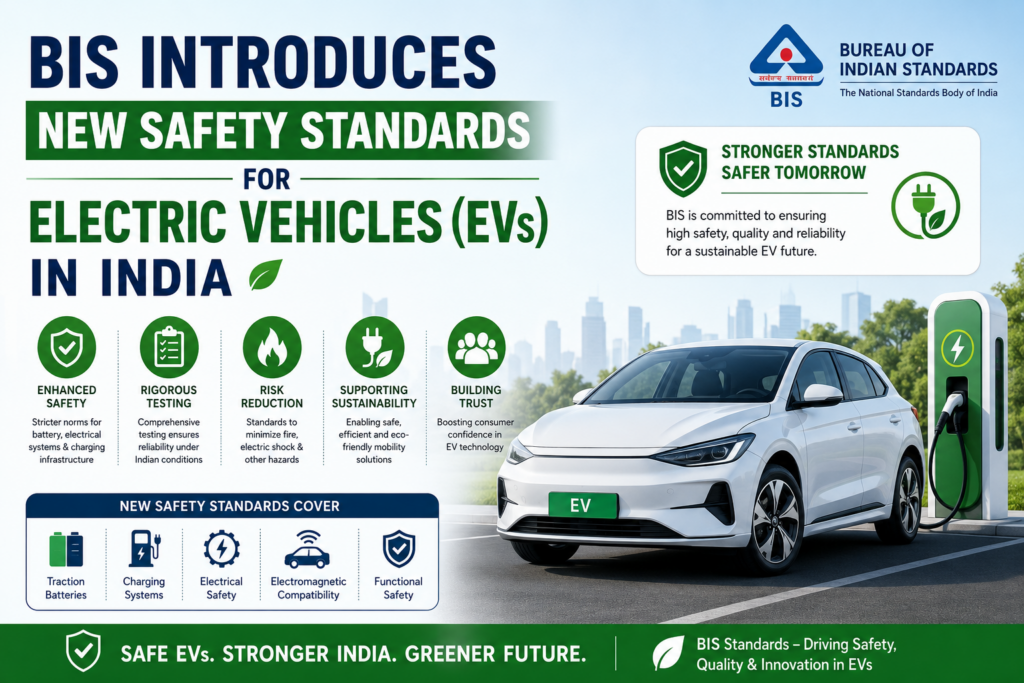
India’s electric vehicle (EV) market is changing dramatically. As consumers become more environmentally conscious and the government continues to promote sustainable transportation, the demand for electric vehicles has grown significantly. From electric scooters and motorcycles to passenger cars and commercial fleets, EVs are becoming an essential part of India’s mobility future. To support this growth and address safety concerns, the Bureau of Indian Standards (BIS) has introduced new safety standards for Electric Vehicles (EVs) in India.
These updated standards are aimed at improving the safety, quality, and reliability of electric vehicles and their critical components. The initiative is expected to strengthen consumer trust, encourage responsible manufacturing practices, and contribute to the long-term success of the EV sector.
Why New Safety Standards Are Important
As EV adoption increases, ensuring vehicle safety has become a major concern for manufacturers, regulators, and consumers. Unlike traditional vehicles, electric vehicles rely heavily on batteries, electronic control systems, and charging infrastructure. Any malfunction in these components can pose serious risks.
In recent years, reports of battery overheating and fire incidents have highlighted the need for stricter safety regulations. To address these challenges, BIS has developed enhanced standards that focus on preventing technical failures and ensuring that EVs can operate safely under different environmental and usage conditions.
The new regulations provide a structured framework for testing, quality control, and performance evaluation, helping manufacturers deliver safer products to the market.
Role of BIS in the EV Industry
The Bureau of Indian Standards is India’s national standards authority responsible for creating and implementing quality benchmarks across industries. BIS standards help ensure that products meet specific safety, reliability, and performance requirements before reaching consumers.
In the electric vehicle sector, BIS plays a critical role in establishing guidelines for batteries, charging systems, electrical components, and vehicle performance. The introduction of these new safety standards reflects the organization’s commitment to supporting India’s transition toward cleaner and safer transportation.
Key Features of the New EV Safety Standards
Enhanced Battery Safety Testing
The most crucial part of an electric car is the battery. Since batteries store large amounts of electrical energy, they must be tested thoroughly to prevent failures.
Under the new BIS standards, batteries must undergo extensive testing for:
- Overcharging conditions
- Short-circuit resistance
- Thermal stability
- Mechanical shock tolerance
- Vibration resistance
- Water and dust protection
- Extreme temperature performance
These tests help ensure that batteries remain stable and safe throughout their operational life.
Thermal Runaway Protection
Thermal runaway is one of the most significant safety risks associated with lithium-ion batteries. It occurs when a battery cell experiences uncontrolled heat generation, potentially leading to fire or explosion.
The updated standards require manufacturers to implement advanced thermal management systems that can detect abnormal temperature increases and activate protective measures before dangerous conditions develop.
This requirement significantly improves battery safety and reduces the risk of fire-related incidents.
Advanced Battery Management Systems (BMS)
The new BIS standards place strong emphasis on Battery Management Systems, commonly known as BMS. These systems continuously monitor battery performance and ensure safe operation.
A compliant BMS should be capable of:
- Monitoring cell voltage
- Regulating charging and discharging cycles
- Controlling battery temperature
- Detecting faults
- Preventing overcharging
- Managing battery health
These features improve both safety and battery longevity.
Improved Charging Safety
Safe charging is essential for the successful adoption of electric vehicles. Faulty charging systems can damage batteries and create safety hazards.
The updated standards introduce strict requirements for:
- Charging connectors
- Electrical insulation
- Overcurrent protection
- Short-circuit prevention
- Safe user interaction
- Charging equipment compatibility
These measures ensure a secure charging experience for EV users.
Vehicle-Level Safety Compliance
In addition to battery-related requirements, BIS has also introduced standards for overall vehicle safety.
Manufacturers must conduct testing related to:
- Electrical system reliability
- Environmental performance
- Component durability
- Structural integrity
- Functional safety
This comprehensive evaluation ensures that electric vehicles can perform safely under real-world operating conditions.
Benefits of the New Standards
Greater Consumer Confidence
One of the biggest advantages of these standards is increased trust among consumers. Knowing that electric vehicles meet strict safety requirements encourages more people to consider EVs as a reliable transportation option.
Higher Product Quality
Manufacturers must follow rigorous testing and quality assurance procedures, leading to better product consistency and performance.
Reduced Safety Risks
Enhanced safety measures help minimize the chances of battery failures, electrical faults, and fire incidents.
Improved Industry Reputation
A well-regulated industry attracts greater investment and supports long-term market growth. Strong safety standards help establish India as a reliable EV manufacturing hub.
Support for Sustainable Transportation
Safe and dependable electric vehicles encourage wider adoption, helping reduce pollution and dependence on fossil fuels.
Impact on Manufacturers
The introduction of new BIS safety standards requires manufacturers to strengthen their product development and testing processes. Companies must invest in advanced technologies, quality management systems, and compliance procedures to meet the updated requirements.
While this may increase initial development costs, it also offers significant benefits, including:
- Improved product reliability
- Reduced warranty claims
- Enhanced customer satisfaction
- Stronger brand image
- Better market competitiveness
Manufacturers that prioritize compliance will be better positioned to succeed in an increasingly competitive EV market.
Future of Electric Mobility in India
India is actively promoting electric mobility through various government initiatives, incentives, and infrastructure development programs. The success of these efforts depends not only on affordability and accessibility but also on consumer confidence in vehicle safety.
The new BIS standards provide a strong foundation for the future growth of the EV sector by ensuring that vehicles meet high-quality safety benchmarks. As technology continues to evolve, these standards will help support innovation while maintaining consumer protection.
Conclusion
The introduction of new safety standards for Electric Vehicles (EVs) in India by BIS is a significant step toward building a safer and more reliable electric mobility ecosystem in India. By focusing on battery safety, thermal management, charging systems, and overall vehicle performance, these regulations address critical challenges facing the industry.
The updated standards will benefit consumers through improved safety and reliability while encouraging manufacturers to adopt higher quality practices. As India transitions to a more hygienic and sustainable transportation future, BIS safety standards will play a crucial role in ensuring the continued success and growth of the electric vehicle industry.