
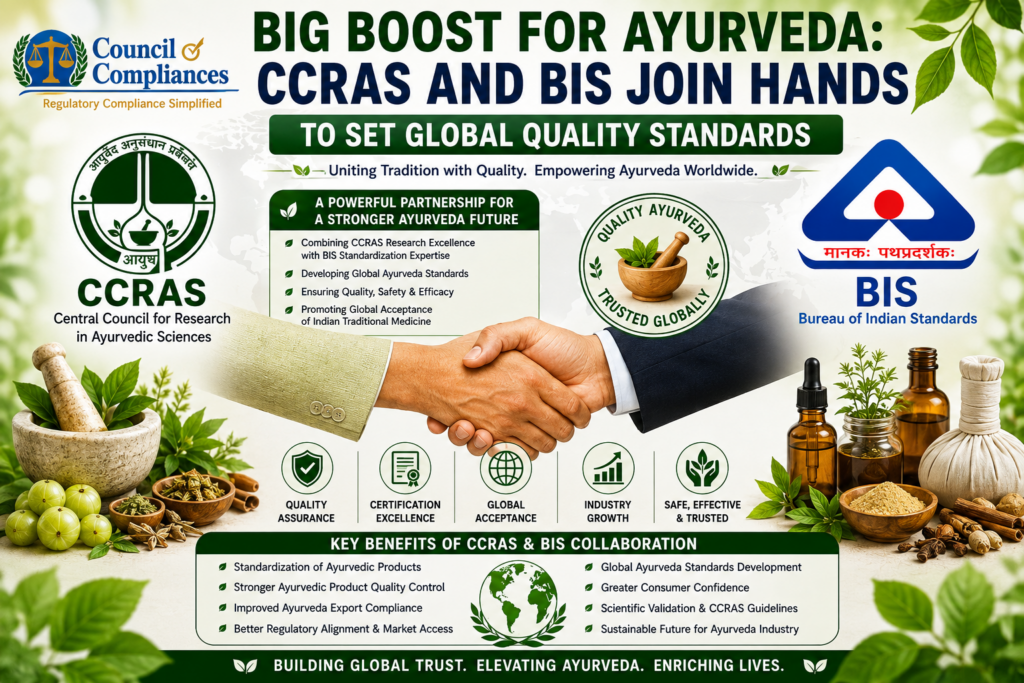
The Indian Ayurveda sector is set to achieve new heights with the landmark initiative Big Boost for Ayurveda: CCRAS and BIS Join Hands to Set Global Quality Standards. This collaboration between the Central Council for Research in Ayurvedic Sciences (CCRAS) and the Bureau of Indian Standards (BIS) is expected to revolutionize the way Ayurvedic products are developed, tested, certified, and marketed worldwide.
As global interest in natural healthcare and wellness solutions continues to grow, the need for consistent quality benchmarks has become increasingly important. The initiative Big Boost for Ayurveda: CCRAS and BIS Join Hands to Set Global Quality Standards aims to establish internationally accepted standards that ensure the safety, effectiveness, and reliability of Ayurvedic products.
This development is being viewed as a major step toward strengthening India’s position in the global traditional medicine market.
The Vision Behind the CCRAS and BIS Collaboration
The CCRAS is recognized as India’s leading research organization dedicated to Ayurvedic sciences. BIS, on the other hand, is responsible for creating national standards that improve quality and consumer protection across industries.
Through this BIS Collaboration, both organizations are working together to establish comprehensive Ayurveda Quality Standards that support industry growth while maintaining the authenticity of traditional medicine.
The initiative Big Boost for Ayurveda: CCRAS and BIS Join Hands to Set Global Quality Standards reflects a shared commitment to promoting excellence and innovation within the Ayurveda ecosystem.
Importance of Standardization in Ayurveda
The Ayurveda industry consists of thousands of manufacturers producing a wide range of herbal and healthcare products. Without proper standardization, product quality can vary significantly.
The Standardization of Ayurvedic Products helps address these challenges by ensuring:
- Consistent manufacturing practices
- Reliable product performance
- Improved consumer confidence
- Better regulatory compliance
- Enhanced product safety
- Increased market credibility
The initiative Big Boost for Ayurveda: CCRAS and BIS Join Hands to Set Global Quality Standards provides a structured framework for achieving these objectives.
Strengthening Ayurvedic Products Certification
One of the most important outcomes of this collaboration will be the enhancement of Ayurvedic Products Certification systems. Certification verifies that products meet established quality, safety, and performance requirements.
Key certification areas may include:
- Ingredient sourcing
- Manufacturing processes
- Laboratory testing
- Packaging standards
- Product labeling
- Quality documentation
By improving Herbal Product Certification, the initiative will support greater transparency and accountability throughout the supply chain.
The implementation of Big Boost for Ayurveda: CCRAS and BIS Join Hands to Set Global Quality Standards will encourage manufacturers to adopt internationally recognized best practices.
Advancing Global Ayurveda Standards
International consumers increasingly expect products to meet strict quality and regulatory requirements. The development of Global Ayurveda Standards will help Indian manufacturers satisfy these expectations while expanding into new markets.
Benefits include:
- Easier international registrations
- Increased export opportunities
- Stronger brand reputation
- Improved regulatory acceptance
- Enhanced consumer trust
The initiative Big Boost for Ayurveda: CCRAS and BIS Join Hands to Set Global Quality Standards is expected to accelerate the Global Acceptance of Ayurveda across healthcare and wellness sectors.
Role of BIS Quality Certification and CCRAS Guidelines
The success of this initiative depends on clear and practical standards. BIS Quality Certification will provide manufacturers with measurable quality benchmarks, while CCRAS Guidelines will ensure scientific and technical consistency.
These measures will improve:
- Product quality control
- Manufacturing efficiency
- Safety assurance
- Research validation
- Regulatory compliance
The focus on Quality Assurance in Ayurveda will strengthen the industry’s credibility both domestically and internationally.
Supporting Ayurveda Export Compliance
Exports represent a significant growth opportunity for India’s Ayurveda sector. However, international markets often require detailed evidence of product quality and regulatory compliance.
Enhanced Ayurveda Export Compliance measures will help businesses demonstrate adherence to recognized standards and gain access to global markets.
Organizations such as councilofcompliances assist businesses in understanding certification requirements, regulatory obligations, and compliance procedures related to healthcare and traditional medicine industries.
The initiative Big Boost for Ayurveda: CCRAS and BIS Join Hands to Set Global Quality Standards is expected to simplify compliance processes and improve export competitiveness.
Benefits for the Ayurveda Industry
The collaboration offers several advantages for manufacturers, healthcare practitioners, exporters, and consumers:
For Manufacturers
- Better market credibility
- Improved product consistency
- Stronger compliance systems
For Exporters
- Easier market access
- Enhanced international acceptance
- Reduced regulatory barriers
For Consumers
- Higher product quality
- Increased safety assurance
- Greater confidence in Ayurvedic products
For Healthcare Providers
- Reliable treatment options
- Standardized formulations
- Better patient outcomes
The initiative Big Boost for Ayurveda: CCRAS and BIS Join Hands to Set Global Quality Standards is expected to benefit every stakeholder in the Ayurveda value chain.
Future of Ayurveda Certification India
As the Ayurveda sector continues to evolve, effective certification and standardization will become increasingly important. The collaboration between CCRAS and BIS creates a strong foundation for the future of Ayurveda Certification India and supports the long-term development of the industry.
The initiative Big Boost for Ayurveda: CCRAS and BIS Join Hands to Set Global Quality Standards demonstrates India’s dedication to promoting Indian Traditional Medicine on the global stage while ensuring the highest levels of quality and safety.
Conclusion
The partnership between CCRAS and BIS represents a transformative milestone for the Ayurveda industry. By introducing stronger quality standards, improving certification systems, and supporting international compliance, this initiative will help Indian Ayurvedic products achieve greater recognition worldwide.
The announcement of Big Boost for Ayurveda: CCRAS and BIS Join Hands to Set Global Quality Standards highlights a future where Ayurveda is supported by robust scientific standards, trusted certification systems, and global quality benchmarks.
FAQs
1. What is the CCRAS and BIS collaboration?
It is a partnership aimed at developing quality standards and certification systems for Ayurvedic products and services.
2. Why are Ayurveda Quality Standards necessary?
They ensure product safety, consistency, effectiveness, and consumer confidence.
3. What is BIS Quality Certification?
It is a certification process that verifies compliance with established quality standards.
4. How will this initiative help exporters?
It strengthens Ayurveda Export Compliance and supports international market access.
5. What are Global Ayurveda Standards?
They are internationally recognized benchmarks for quality, safety, and manufacturing practices.
6. How does standardization benefit consumers?
It provides assurance that products are safe, reliable, and consistently manufactured.
7. What is the future impact of this initiative?
It will improve global trust, increase exports, strengthen regulations, and promote the worldwide acceptance of Ayurveda.