
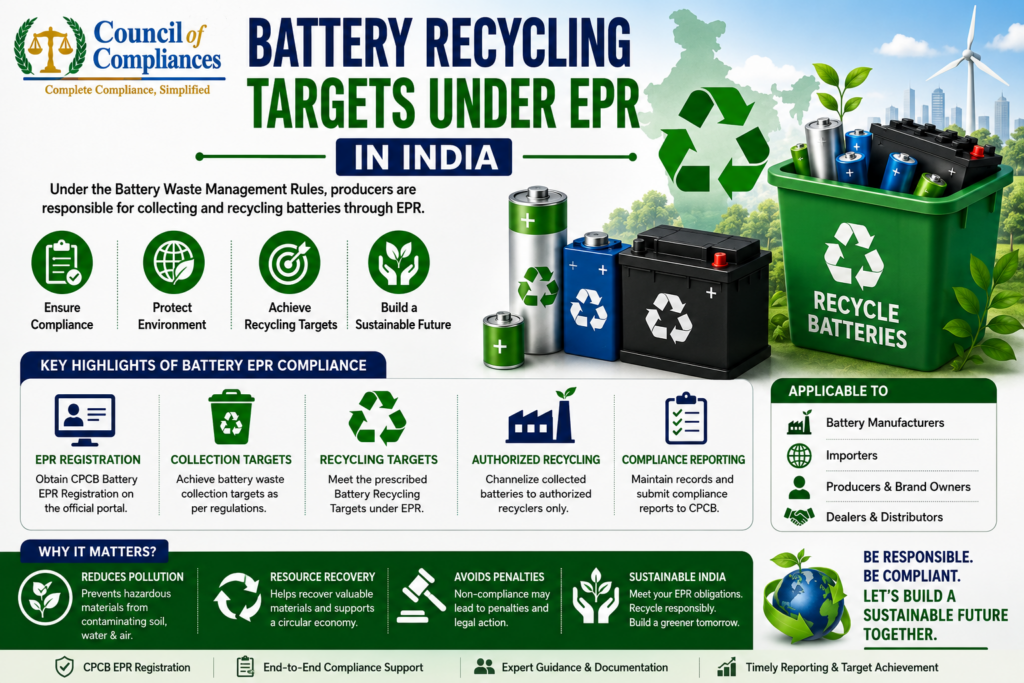
India’s commitment to environmental sustainability has led to the introduction of stricter regulations for managing battery waste. One of the most significant requirements under the Battery Waste Management Rules is the implementation of Battery Recycling Targets Under EPR in India. These targets ensure that battery producers, importers, and brand owners take responsibility for collecting and recycling batteries after their useful life.
As battery usage continues to rise due to electric vehicles, consumer electronics, energy storage systems, and industrial applications, compliance with Battery Recycling Targets Under EPR in India has become essential. Businesses must understand their responsibilities and establish effective systems to manage battery waste in accordance with national regulations.
Understanding Battery Recycling Targets Under EPR in India
The framework of Battery Recycling Targets Under EPR in India is based on the principle of Extended Producer Responsibility (EPR). Under this approach, producers are accountable for ensuring that a prescribed quantity of battery waste is collected and recycled through authorized channels.
The purpose of Battery Recycling Targets Under EPR in India is to:
- Reduce environmental pollution caused by battery disposal
- Promote recovery of valuable materials
- Encourage sustainable waste management practices
- Strengthen the circular economy
- Improve resource efficiency
These obligations are monitored through the CPCB Battery EPR Registration system and associated compliance reporting mechanisms.
Battery Waste Management Rules India
The Battery Waste Management Rules India provides a comprehensive framework for battery waste handling. The regulations apply to:
- Battery manufacturers
- Importers
- Producers
- Brand owners
- Dealers and distributors
To comply with Battery Recycling Targets Under EPR in India, businesses must register on the CPCB EPR Battery Portal and fulfill specified recycling obligations.
The rules cover multiple battery categories, including:
- Portable batteries
- Automotive batteries
- Industrial batteries
- Electric vehicle batteries
Key Requirements Under EPR for Battery Waste
Businesses must implement several measures to comply with Battery Recycling Targets Under EPR in India.
CPCB Battery EPR Registration
The first requirement is obtaining CPCB Battery EPR Registration through the designated online portal.
Battery Collection System
Organizations must establish effective collection channels to meet Battery Waste Collection Targets.
Authorized Recycling
Collected batteries must be transferred only to approved recycling facilities.
Documentation and Record Keeping
Accurate records of battery sales, collection, transportation, recycling, and EPR certificates must be maintained.
Compliance Reporting
Regular reporting demonstrates fulfillment of Battery Recycling Targets Under EPR in India and supports regulatory transparency.
Importance of Battery Recycling Compliance India
Compliance with battery recycling regulations offers benefits beyond legal obligations.
Environmental Benefits
Proper battery recycling reduces contamination of soil, water, and air caused by hazardous substances.
Resource Conservation
Valuable materials such as lithium, cobalt, nickel, and lead can be recovered and reused.
Regulatory Security
Businesses complying with Battery Recycling Targets Under EPR in India minimize the risk of penalties and enforcement actions.
Brand Enhancement
Companies demonstrating environmental responsibility gain stronger trust among customers, investors, and stakeholders.
Sustainable Growth
Compliance contributes to long-term sustainability and corporate governance objectives.
Battery Recycling Obligations India for Producers
Under the EPR framework, producers are responsible for:
- Registering with CPCB
- Meeting Battery Waste Recycling Targets
- Achieving Battery Collection and Recycling Targets
- Partnering with authorized recyclers
- Maintaining compliance documentation
- Procuring recycling certificates
- Submitting annual compliance reports
These responsibilities ensure that Battery Recycling Targets Under EPR in India are achieved consistently and effectively.
How CouncilofCompliances Helps Businesses
Navigating Battery Recycling Regulations India can be challenging, especially for organizations operating across multiple markets. CouncilofCompliances provides professional assistance to businesses seeking complete EPR compliance.
Their services include:
- EPR Registration for Battery Manufacturers
- CPCB portal registration support
- Compliance documentation management
- Regulatory advisory services
- Reporting and target fulfillment assistance
- Battery Waste Management Compliance support
By helping organizations understand and implement Battery Recycling Targets Under EPR in India, CouncilofCompliances enables businesses to remain compliant while focusing on operational growth.
Future of Sustainable Battery Recycling India
With the rapid expansion of electric mobility and renewable energy infrastructure, battery demand is expected to increase significantly over the coming years. Effective implementation of Battery Recycling Targets Under EPR in India will play a critical role in managing this growing waste stream.
The continued focus on Sustainable Battery Recycling India will encourage innovation, improve material recovery rates, and strengthen environmental protection efforts across industries.
Conclusion
Compliance with Battery Recycling Targets Under EPR in India is an essential requirement for battery producers, importers, and brand owners. By obtaining CPCB registration, developing collection mechanisms, partnering with authorized recyclers, and maintaining proper documentation, organizations can successfully fulfill their EPR obligations.
Businesses that prioritize Battery Producer Responsibility today will be better prepared for future regulatory developments while contributing to a cleaner and more sustainable India.
Frequently Asked Questions (FAQs)
1. What are the Battery Recycling Targets under EPR in India?
It is a mandatory collection and recycling target for the producers.
2. Who is responsible for the battery EPR compliance?
The manufacturers and importers/producers or brand owners of the batteries and its components, which are put on the Indian market.
3. What is CPCB Battery EPR Registration?
The registration process enabling producers and brands owners to fulfil EPR targets as per the Battery Waste Management Rules.
4. Why is Battery recycling necessary?
It helps in the retrieval of precious metals and prevents the harmful effects on the environment.
5. What are the Battery Collection and Recycling Targets?
They are set targets prescribed to the producers that needs to be achieved via collection and recycling conducted through authorized recyclers.
6. What is the outcome of not meeting the EPR target?
Non-compliance leads to penalties and regulatory action in the form of regulatory fines and environmental compensation.
7. How can CouncilofCompliances assist with battery EPR compliance?
CouncilofCompliances provides registration, documentation, reporting, advisory, and compliance management services for battery producers.