
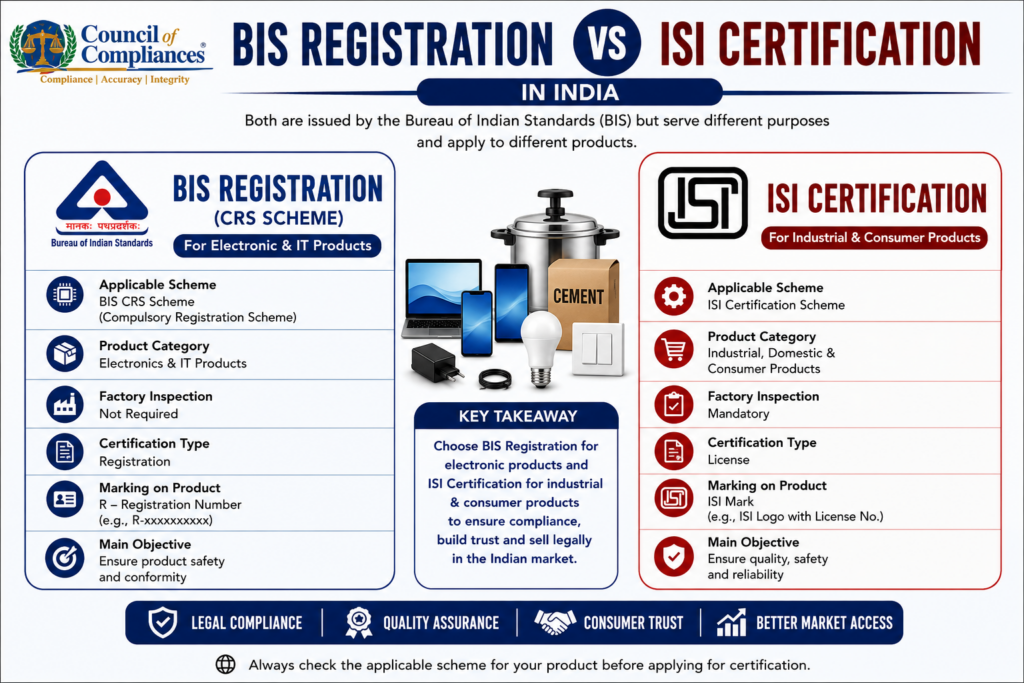
For manufacturers, importers, and brand owners, understanding BIS Registration vs ISI Certification in India is essential before launching products in the Indian market. Both certifications are governed by the Bureau of Indian Standards (BIS), but they apply to different categories of products and involve separate compliance procedures.
With increasing regulatory scrutiny and consumer awareness, obtaining the correct certification has become a critical step for businesses seeking market access. Knowing the differences between BIS Registration vs ISI Certification in India helps organizations avoid compliance issues, delays, and penalties.
Many companies choose expert compliance partners such as councilofcompliances to simplify certification procedures and ensure smooth approvals.
Understanding BIS Registration
BIS Registration India generally refers to certification under the BIS CRS Scheme (Compulsory Registration Scheme). This scheme was introduced to regulate electronic and information technology products and ensure they meet prescribed Indian safety standards.
Manufacturers covered under this scheme must:
- Test products in BIS-recognized laboratories
- Meet relevant Indian standards
- Submit compliance documents
- Obtain BIS authorization before sale
The objective is to improve product quality, safety, and consumer protection.
Understanding ISI Certification
ISI Certification India is a well-established product certification program under which approved manufacturers can use the ISI mark on their products.
The ISI Mark Certification process verifies that products comply with specific Indian Standards and maintain consistent quality levels. Products bearing the ISI mark are widely trusted by consumers and regulatory authorities.
An ISI Mark License is mandatory for many products that directly affect consumer health and safety.
BIS Registration vs ISI Certification in India: Major Differences
When comparing BIS Registration vs ISI Certification in India, several important distinctions emerge.
Product Scope
BIS CRS Registration generally applies to:
- Mobile phones
- LED lighting products
- Laptops
- Power banks
- Electronic accessories
- Smart devices
ISI Certification generally applies to:
- Cement
- Electrical appliances
- Pressure cookers
- Steel products
- Packaged drinking water
- Construction materials
Registration vs License
One key factor in BIS Registration vs ISI Certification in India is the certification structure.
- CRS provides product registration.
- ISI provides a manufacturing license.
Factory Inspection Requirements
Another important aspect of BIS Registration vs ISI Certification in India is factory assessment.
- CRS Registration: Usually does not require factory inspection.
- ISI Certification: Factory inspection is mandatory.
Product Marking Requirements
CRS-certified products display BIS registration details, whereas ISI-certified products display the official ISI mark.
Why BIS Compliance Matters
Whether pursuing BIS Registration vs ISI Certification in India, compliance offers several benefits:
- Legal product sales
- Improved consumer confidence
- Stronger brand reputation
- Regulatory compliance
- Better product quality
- Reduced business risk
Today, BIS Compliance India is a key factor in maintaining market credibility and long-term business growth.
Products Requiring BIS Registration
Products commonly requiring Mandatory BIS Registration include:
- LED lamps
- Mobile phones
- Smart televisions
- Printers
- Tablets
- Computer peripherals
- Electronic accessories
Manufacturers must complete the BIS Approval Process before these products can be sold in India.
Products Requiring ISI Certification
Products requiring ISI Mark Certification often include:
- Cement products
- Electrical switches
- Household appliances
- Construction materials
- Kitchen equipment
- Water-related products
An ISI Mark for Manufacturers demonstrates adherence to stringent Indian quality requirements.
BIS Approval Process
The BIS Approval Process under the CRS scheme generally includes:
Step 1: Product Testing
Products are tested in BIS-recognized laboratories.
Step 2: Documentation
Manufacturers prepare technical and compliance documents.
Step 3: Application Submission
Applications are submitted through the BIS portal.
Step 4: Review and Verification
BIS reviews submitted records and test reports.
Step 5: Registration Approval
Upon successful evaluation, registration is granted.
This process supports efficient Product Testing and Certification.
ISI Certification Process
The ISI certification process generally includes:
- Product testing
- Factory inspection
- Sample verification
- Quality system assessment
- License approval
- Ongoing surveillance
Compared with CRS registration, ISI certification involves a more detailed compliance review.
Benefits of Hiring Certification Experts
Managing BIS Registration vs ISI Certification in India can be complicated due to technical documentation and changing regulatory requirements.
An experienced BIS Registration Consultant or ISI Certification Consultant can assist with:
- Product classification
- Standard identification
- Laboratory coordination
- Application filing
- Compliance assessment
- Regulatory support
Professional guidance can significantly improve approval efficiency and reduce compliance risks.
Conclusion
Understanding BIS Registration vs ISI Certification in India is crucial for businesses seeking to manufacture, import, or distribute products in the Indian market. While BIS CRS Registration focuses primarily on electronic and IT products, ISI Mark Certification covers a broader range of industrial and consumer goods.
Selecting the correct certification pathway ensures compliance with BIS Standards India, supports product quality, and enhances consumer trust. Businesses should evaluate their product category carefully and seek expert assistance when needed to achieve successful certification outcomes.
FAQs
1. What is the difference between BIS Registration and ISI Certification?
BIS Registration applies mainly to electronic products under CRS, while ISI Certification applies to products requiring the ISI mark.
2. Is BIS Registration mandatory in India?
Yes, many notified electronic products require Mandatory BIS Registration before sale.
3. What is an ISI Mark License?
It is a license issued by BIS that permits manufacturers to use the ISI mark on certified products.
4. Does BIS CRS Registration require factory inspection?
Generally, factory inspection is not required under the CRS scheme.
5. Why is ISI Certification important?
It ensures products meet Indian quality and safety standards.
6. Can foreign manufacturers obtain BIS certification?
Yes, foreign manufacturers can apply for both BIS CRS Registration and ISI Certification where applicable.
7. Why should businesses hire a BIS Registration Consultant?
Consultants help with documentation, testing, application filing, compliance reviews, and approval management.