
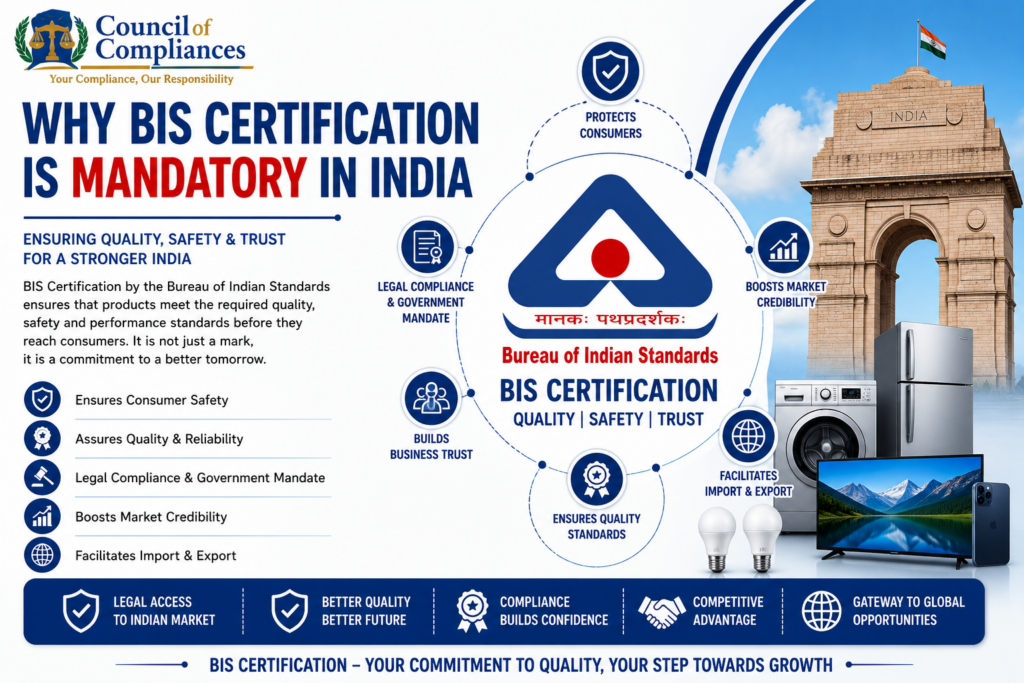
As India’s economy continues to expand and consumer awareness increases, maintaining product quality and safety has become more important than ever. This is exactly Why BIS Certification is Mandatory in India for a wide range of products sold, manufactured, or imported into the country. The Bureau of Indian Standards (BIS) serves as the national standards authority responsible for ensuring that products meet established quality and safety benchmarks.
For manufacturers, importers, and foreign companies entering the Indian market, understanding Why BIS Certification is Mandatory in India is essential for regulatory compliance and business growth. Certification not only fulfills legal obligations but also enhances consumer trust and market credibility.
What is BIS Certification India?
BIS Certification India is a conformity assessment system that verifies whether products comply with applicable Indian standards. Through this framework, the Bureau of Indian Standards Certification program ensures that products meet predefined requirements related to quality, safety, reliability, and performance.
Products falling under mandatory certification categories must obtain the necessary approvals before they can be legally sold in India. This regulatory framework clearly explains Why BIS Certification is Mandatory in India for businesses operating across different industries.
Why Businesses Need Mandatory BIS Certification
The Government of India has implemented strict quality control measures to protect consumers and strengthen market confidence. As a result, Mandatory BIS Certification has become a critical requirement for many product categories.
The primary objectives include:
- Ensuring consumer safety
- Maintaining product quality consistency
- Supporting fair market competition
- Preventing the sale of substandard products
- Enhancing product reliability
- Promoting compliance with Indian regulations
- Encouraging responsible manufacturing practices
These objectives highlight Why BIS Certification is Mandatory in India and why businesses must prioritize compliance.
BIS Compliance Requirements for Market Entry
Companies seeking to manufacture, import, or distribute regulated products must comply with various BIS Compliance Requirements.
Key requirements typically include:
- Product testing
- Technical documentation
- Application filing
- Quality assessment
- Standard conformity verification
- Certification approval
- Ongoing surveillance compliance
Meeting these requirements helps organizations maintain BIS Regulatory Compliance and operate without legal interruptions.
BIS Certification for Manufacturers
Indian manufacturers must obtain BIS Certification for Manufacturers when producing goods covered under mandatory standards. Certification confirms that products comply with applicable regulations and quality specifications.
Benefits include:
- Improved product credibility
- Increased customer confidence
- Legal authorization to sell products
- Better quality management
- Stronger competitive positioning
For many industries, understanding Why BIS Certification is Mandatory in India begins with maintaining manufacturing excellence and regulatory compliance.
BIS Certification for Importers and Foreign Manufacturers
Imported products are subject to the same quality and safety standards as domestically manufactured goods. Therefore, BIS Certification for Importers is required for many regulated products entering India.
Likewise, BIS Certification for Foreign Manufacturers enables overseas producers to legally market their products in India while complying with national standards.
Certification provides:
- Easier customs clearance
- Legal market access
- Consumer trust
- Regulatory compliance
- Reduced risk of penalties
These benefits further demonstrate Why BIS Certification is Mandatory in India for global businesses.
BIS Certification for Electronics
Electronics remain one of the largest categories regulated by BIS. Through BIS CRS Registration, manufacturers and importers must certify various electronic and IT products before sale.
Examples include:
- Mobile phones
- Laptops
- Smart devices
- LED televisions
- Chargers
- Power banks
- Electronic accessories
The emphasis on electrical safety and performance is a major reason Why BIS Certification is Mandatory in India for the electronics industry.
BIS Certification Process
The BIS Certification Process generally follows a structured approach:
Product Identification
Determine the applicable standard and certification scheme.
Laboratory Testing
Conduct testing through BIS-recognized laboratories.
Documentation Preparation
Compile technical specifications and compliance records.
Application Submission
Submit the certification application.
Evaluation and Approval
BIS reviews the application and test results.
BIS License India Issuance
Certification is granted upon successful compliance verification.
Businesses often engage a BIS Registration Consultant to ensure smooth execution of these steps.
Why Choose CouncilofCompliances for BIS Certification Services?
CouncilofCompliances offers specialized BIS Certification Services India for manufacturers, importers, startups, and multinational organizations. Their experienced professionals assist businesses with BIS Scheme Registration, testing coordination, documentation management, and approval procedures.
Whether your organization requires BIS Product Certification, BIS Mark Certification, BIS Approval for Products, or complete compliance management, CouncilofCompliances provides comprehensive support throughout the certification journey.
Their expertise helps businesses understand Why BIS Certification is Mandatory in India while minimizing delays and ensuring full regulatory compliance.
BIS Certification Benefits
Organizations that obtain certification enjoy numerous advantages:
- Legal compliance
- Enhanced brand reputation
- Improved customer trust
- Better product quality assurance
- Expanded market opportunities
- Reduced compliance risks
- Stronger business growth potential
These advantages clearly reinforce Why BIS Certification is Mandatory in India for businesses seeking long-term success.
Conclusion
The importance of product quality, safety, and regulatory compliance continues to grow in India. Understanding Why BIS Certification is Mandatory in India allows businesses to meet legal requirements, gain consumer confidence, and access larger markets. Whether you are a manufacturer, importer, or foreign producer, obtaining BIS certification is a vital step toward sustainable growth and compliance with Indian Product Standards.
FAQs
1. Why BIS Certification is Mandatory in India?
BIS=BOI..goods that conform to the standards specified by the Indian authorities.
2. Who requires BIS Certification India?
Regulated products to be manufactured, imported and/or available in India by manufacturers, importers and foreign manufacturers-Manufacturers for India, importers for India, Foreign manufacturers of Regulated products
3. What is BIS Scheme Registration?
It is the procedure to declare products to concerned BIS certification schemes.
4. What products require BIS certification?
Electronics, consumer massmarket products, industrial, and regulated items. Some products need certification for:
5. What is BIS Mark Certification?
Approved use issued by the BIS mark- The authorization to the use of the BIS mark, on the certified products.
6. How does BIS certification benefit businesses?
Is good for compliance, customer confidence, market access and product credibility.
7. Can foreign manufacturers obtain BIS certification?
Yes, foreign manufacturer can initiate application for selling into India through specified BIS certification scheme.