
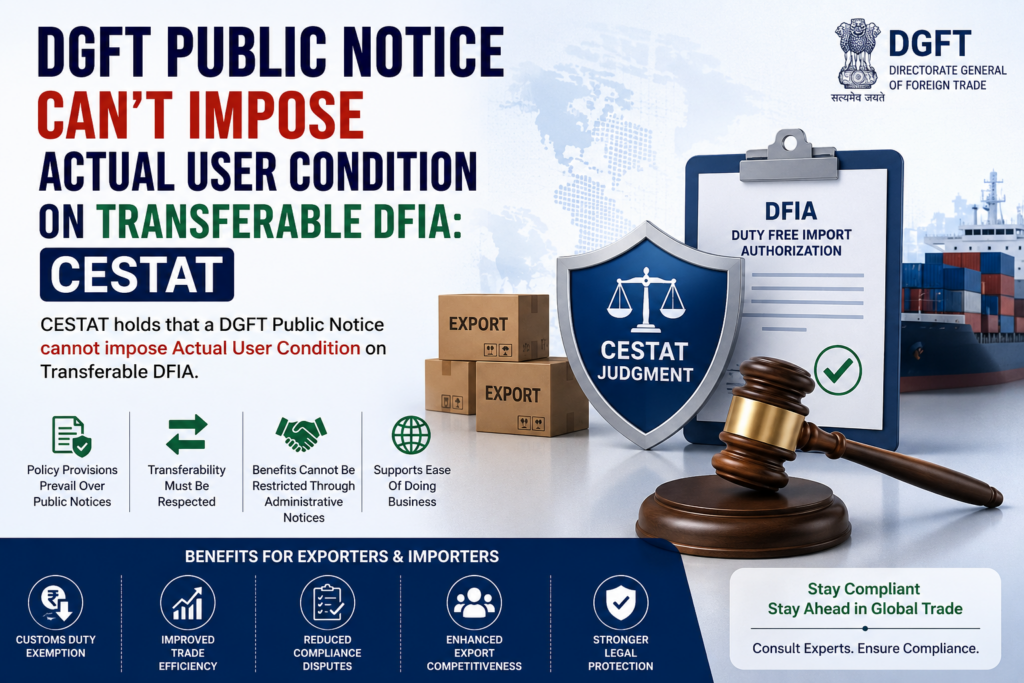
The landmark ruling that DGFT Public Notice Can’t Impose Actual User Condition on Transferable DFIA: CESTAT has significantly impacted India’s export-import sector. The decision reinforces the legal principle that benefits granted under the Foreign Trade Policy cannot be restricted through administrative notices. For exporters and importers utilizing the DFIA Scheme India, this judgment provides greater clarity, confidence, and regulatory certainty DGFT Public Notice Can’t Impose Actual User Condition on Transferable DFIA: CESTAT.
At councilofcompliances, we help businesses navigate evolving trade regulations and understand the practical implications of important judicial decisions such as the DGFT Public Notice Can’t Impose Actual User Condition on Transferable DFIA: CESTAT ruling.
Understanding the DFIA Scheme India
The DFIA Scheme India is one of the most beneficial export promotion schemes available to Indian exporters. Under this scheme, exporters can import raw materials, components, and inputs required for manufacturing export products without paying customs duties.
The primary objective of the Duty Free Import Authorization scheme is to reduce manufacturing costs and enhance the competitiveness of Indian products in global markets. Once the exporter fulfills the required export obligations, the authorization can become transferable, creating additional flexibility and commercial value.
The DGFT Public Notice Can’t Impose Actual User Condition on Transferable DFIA: CESTAT judgment safeguards this transferability and protects the intended benefits of the scheme.
What is the Actual User Condition?
The Actual User Condition is a regulatory requirement that restricts the use of imported goods to the authorization holder. Under such a condition, goods cannot be freely transferred or sold to another entity.
In the context of a Transferable DFIA, imposing an Actual User Condition creates a direct conflict with the concept of transferability. The DGFT Public Notice Can’t Impose Actual User Condition on Transferable DFIA: CESTAT ruling recognized this contradiction and clarified that authorities cannot impose such restrictions through a public notice once transferability has been granted.
This interpretation aligns with the objectives of the Foreign Trade Policy India and promotes ease of doing business.
Highlights of the CESTAT Judgment
The important CESTAT Judgment examined whether a DGFT Public Notice could lawfully impose an Actual User Condition on transferable DFIA licenses.
After reviewing policy provisions and applicable regulations, the tribunal concluded that:
- Transferable DFIA licenses must retain their transferable nature.
- Administrative notices cannot override policy provisions.
- Exporters should receive benefits exactly as provided under the policy.
- Regulatory certainty is essential for international trade.
- Policy interpretation must support trade facilitation.
The DGFT Public Notice Can’t Impose Actual User Condition on Transferable DFIA: CESTAT decision has therefore become a crucial precedent for businesses involved in import-export operations.
Impact on Exporters and Importers
The DGFT Public Notice Can’t Impose Actual User Condition on Transferable DFIA: CESTAT ruling offers several practical benefits:
Improved Business Flexibility
Companies can transfer eligible DFIAs without facing additional restrictions that were not originally part of the scheme.
Greater Commercial Value
The value of transferable authorizations is preserved, allowing businesses to optimize their trade operations.
Reduced Compliance Risks
The judgment simplifies the interpretation of DFIA Transferability Rules and reduces uncertainty.
Enhanced Export Competitiveness
Businesses can fully utilize DFIA Benefits for Exporters, improving profitability and global competitiveness.
Stronger Legal Protection
The ruling protects exporters from policy interpretations that conflict with established trade regulations.
Importance of Trade Policy Compliance
Despite the favorable judgment, businesses must continue maintaining strong Trade Policy Compliance practices. Proper recordkeeping, customs documentation, and regulatory monitoring remain essential for avoiding disputes.
Organizations should regularly review DGFT Notification Updates, changes in DGFT Regulations, and customs circulars to ensure ongoing compliance.
The DGFT Public Notice Can’t Impose Actual User Condition on Transferable DFIA: CESTAT decision demonstrates how critical it is to understand both legal developments and practical compliance requirements.
How councilofcompliances Can Help
At councilofcompliances, we provide comprehensive assistance for:
- DFIA registration and advisory
- DGFT compliance management
- Import Export License India support
- Export incentive consultancy
- Customs compliance reviews
- Regulatory representation
- Trade policy interpretation
- DGFT Consultant Services
Our team helps businesses understand the impact of the DGFT Public Notice Can’t Impose Actual User Condition on Transferable DFIA: CESTAT ruling and leverage available trade benefits effectively.
Why Choose councilofcompliances?
Industry Expertise
Our professionals possess extensive knowledge of international trade regulations and export promotion schemes.
End-to-End Support
From documentation to compliance management, we provide complete assistance.
Timely Guidance
We keep businesses informed about the latest DGFT Notification Updates and policy changes.
Customized Solutions
Every business receives tailored compliance strategies based on its operational requirements.
Trusted Advisory Services
We help organizations achieve seamless Customs Compliance India and maximize incentives available under government schemes.
The DGFT Public Notice Can’t Impose Actual User Condition on Transferable DFIA: CESTAT ruling reinforces the importance of protecting policy benefits and ensuring fair implementation of trade regulations.
Frequently Asked Questions (FAQs)
1. What is DFIA?
DFIA stands for Duty Free Import Authorization, a scheme allowing duty-free imports for export production.
2. What is a Transferable DFIA?
It is a DFIA license that can be transferred after completion of export obligations.
3. What is the Actual User Condition in DFIA?
It is a restriction requiring imported goods to be used only by the original authorization holder.
4. What did the CESTAT ruling decide?
The tribunal held that a DGFT public notice cannot impose an Actual User Condition on a transferable DFIA.
5. Why is the judgment significant?
It protects the transferability benefits granted under the Foreign Trade Policy.
6. How does the ruling help exporters?
It preserves the commercial value and flexibility of transferable DFIA licenses.
7. Does the decision affect customs duty exemptions?
Yes, it supports the proper utilization of customs duty exemption benefits under transferable DFIA authorizations.
8. How can councilofcompliances assist businesses?
councilofcompliances offers DFIA advisory, DGFT compliance services, customs guidance, and export-import consulting solutions.