
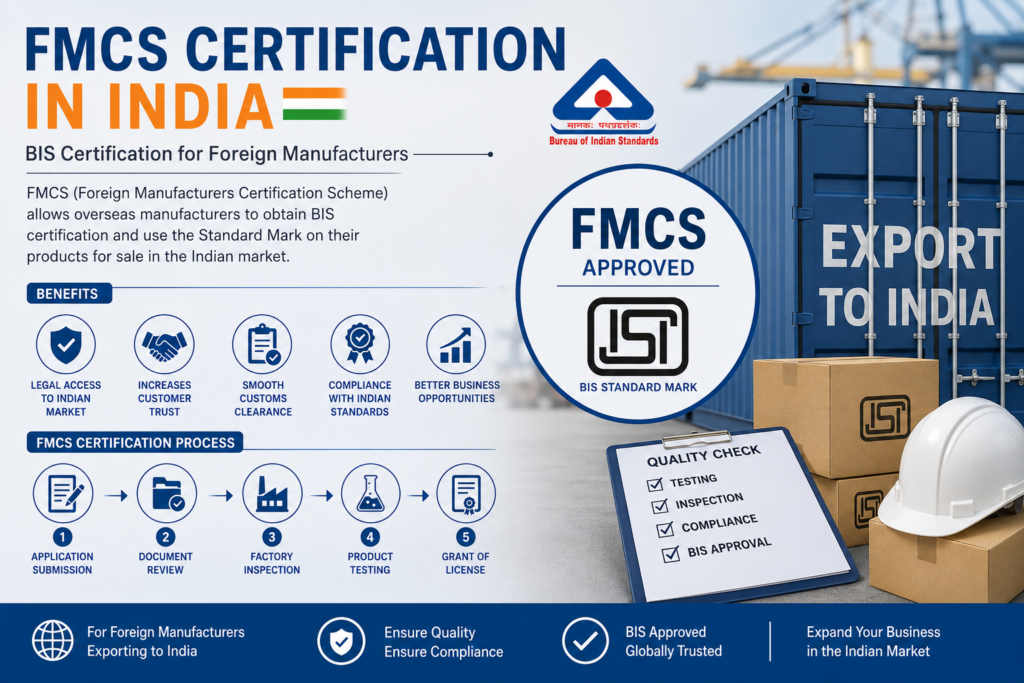
India has emerged as a major global trade destination for manufacturers across industries. However, foreign companies planning to sell products in India must comply with mandatory safety and quality regulations established by the Bureau of Indian Standards. One of the most critical compliance requirements is obtaining FMCS Certification in India.
The certification is issued under the Foreign Manufacturers Certification Scheme, which enables overseas manufacturers to use the BIS Standard Mark on products approved for the Indian market. This certification confirms that imported goods meet Indian quality and safety standards.
In this guide by Council of Compliances, we explain the FMCS certification process, eligibility, required documents, approval stages, and business benefits for foreign manufacturers.
What is FMCS Certification in India?
FMCS Certification in India is a BIS-operated certification system designed for manufacturers located outside India. It allows foreign companies to obtain permission to sell products in India under applicable Indian Standards.
Under this scheme, manufacturers receive a Foreign Manufacturer BIS License after successful testing and inspection. Approved companies can then use the BIS Standard Mark India on certified products.
The primary objective of the certification is to ensure imported products meet the same quality benchmarks applicable to domestic manufacturers.
Understanding the Foreign Manufacturers Certification Scheme
The Foreign Manufacturers Certification Scheme is managed by BIS to regulate the quality and safety of imported goods entering the Indian market.
The scheme includes:
- Product testing
- Factory inspection
- Quality verification
- Compliance evaluation
Manufacturers must prove that their production systems consistently meet Indian Standards before certification approval is granted.
The FMCS Certification in India framework is particularly important for industries dealing with regulated and safety-sensitive products.
Importance of BIS FMCS Certification
Obtaining BIS FMCS Certification provides several commercial and regulatory benefits to foreign businesses.
Compliance with Indian Laws
Many products require mandatory BIS approval before they can be imported or sold in India.
Enhanced Product Credibility
Products carrying the BIS Standard Mark India are generally considered safer and more reliable by Indian consumers and distributors.
Easier Customs Clearance
Certified products face fewer import-related complications and documentation issues.
Improved Market Access
Companies with active BIS Certification India approvals can expand business operations more efficiently in India.
Products Covered Under FMCS Registration India
The FMCS Registration India process applies to multiple product categories such as:
- Electrical appliances
- Steel and metal products
- Cement materials
- Automotive components
- Industrial machinery
- Pressure cookers
- Chemicals and polymers
Manufacturers should verify the applicable Indian Standard for their products before applying.
Step-by-Step FMCS Approval Process
The FMCS Approval Process involves several technical and regulatory stages.
Step 1: Application Submission
The manufacturer submits an application to BIS with technical specifications, product details, and supporting documentation.
Step 2: Product Testing
Product samples are tested in BIS-recognized laboratories to verify compliance with Indian Standards.
Step 3: Factory Inspection
BIS officials inspect the overseas manufacturing unit to assess production capability and quality control systems.
Step 4: Technical Assessment
BIS evaluates inspection reports, testing results, and compliance records.
Step 5: License Grant
After successful verification, the manufacturer receives a BIS License for Foreign Manufacturers.
The approved company may then use the BIS Standard Mark on certified products sold in India.
Documents Required for FMCS Certification
Manufacturers applying for FMCS Certification in India generally need the following:
- Factory registration documents
- Product specifications
- Manufacturing process details
- Quality control manuals
- Product test reports
- Trademark authorization documents
- Authorized Indian Representative details
Accurate documentation plays a vital role in avoiding approval delays.
Role of Authorized Indian Representative
Foreign companies must appoint an Authorized Indian Representative (AIR) during the certification process.
The AIR acts as the local liaison between BIS and the manufacturer and helps with:
- Regulatory communication
- Submission of documents
- Compliance coordination
- Inspection arrangements
This requirement is mandatory under the Foreign Manufacturers Certification Scheme.
Why Hire a BIS FMCS Consultant?
The FMCS process can be technically complex for overseas businesses unfamiliar with Indian regulations. A professional BIS FMCS Consultant helps simplify the process and improve approval efficiency.
Consultants typically assist with:
- Standard identification
- Documentation preparation
- Product testing coordination
- Inspection support
- BIS communication
- Renewal compliance
Working with experts reduces compliance risks and saves time.
Common Challenges in FMCS Certification
Foreign manufacturers often face issues such as:
- Difficulty understanding Indian Standards
- Incomplete technical documentation
- Delays in laboratory testing
- Inspection scheduling challenges
- Regulatory communication barriers
Proper planning and expert guidance can help companies overcome these challenges effectively.
Validity and Renewal of BIS FMCS Certification
The validity period of BIS FMCS Certification depends on BIS regulations and product categories.
To maintain certification, manufacturers must:
- Ensure ongoing compliance
- Maintain production quality
- Submit renewal applications on time
- Cooperate with surveillance audits
Failure to renew the certification may lead to suspension or cancellation of the license.
Business Benefits of FMCS Certification in India
Obtaining FMCS Certification in India offers long-term commercial advantages for foreign manufacturers.
Increased Customer Confidence
Certified products build stronger trust among buyers and distributors.
Better Brand Reputation
Compliance with Indian Standards enhances the manufacturer’s credibility.
Competitive Advantage
Products with BIS approval gain preference in regulated industries and institutional procurement.
Long-Term Market Expansion
Certification helps businesses establish a sustainable presence in India’s growing market.
Conclusion
As India continues to strengthen product quality regulations, obtaining FMCS Certification in India has become essential for foreign manufacturers entering the Indian market. The Foreign Manufacturers Certification Scheme ensures imported products meet Indian safety and quality standards before sale.
From product testing to factory inspection and final approval, the process requires technical accuracy and regulatory compliance. Businesses often partner with experienced professionals like Council of Compliances to simplify certification procedures and ensure faster approvals.
By securing BIS FMCS Certification, overseas manufacturers can improve market access, strengthen brand credibility, and achieve long-term business success in India.
FAQs on FMCS Certification in India
1. What is FMCS Certification in India?
It is a BIS certification scheme for foreign manufacturers exporting products to India.
2. What does BIS FMCS Certification mean?
It refers to certification issued under the Foreign Manufacturers Certification Scheme operated by BIS.
3. Is factory inspection compulsory under FMCS?
Yes, BIS conducts inspections at the foreign manufacturing facility before approval.
4. What is the role of the Authorized Indian Representative?
The AIR acts as the local contact person between BIS and the foreign manufacturer.
5. How long does the FMCS approval process take?
The process duration depends on testing, inspection, and documentation completion.
6. Can manufacturers use the BIS Standard Mark after approval?
Yes, certified manufacturers can use the BIS Standard Mark India on approved products.
7. Why should companies hire a BIS FMCS Consultant?
Consultants help manage documentation, testing, inspections, and regulatory compliance efficiently.